

Overview
- A set of phase modulation sidebands are imposed to the main laser beam for control of the mode cleaner cavity and the main interferometer. The frequency of the sidebands are determined from the signal extraction and control scheme: 11MHz, 29.5MHz, and 55MHz.
- We are investigating a multiply resonant circuit to be attached to EOM in order to create those three pairs of sidebands with a single crystal.
- The advantage in use of a mutli resonant EOM is to able to take Mach-Zehnder away from the injection table.
The feasibility and the basic ideas of the triple resonant circuit was investigated by Stephanie Erickson, a 40m SURF student in 2009 Summer. Link to Stephanie's descriptions
Steps for Development
studying the principle of LC circuit + transformer

investigation of loss effect in LC circuit
make a test circuit (single resonant) with highest impedance
( - Dec.20) cross checking the resultant impedance by using Peter's impedance analyzer at PSL lab.
( Dec.23) prepare a transformer for matching the impedance of the test circuit
( - Dec. 25) performance test by using optical spectrum analyzer
( - Dec. 31) study of triple resonant circuit
(- Jan.5) investigation of loss effect in the multi-resonant circuit
( - Jan.12) make a prototype circuit with highest impedance
( - Jan.20) performance test of prototype by optical spectrum analyzer
( - Jan. 25) final design and ordering

performance test with company-made circuit
installation
Contents
1. Conceptual idea
- The goal of this development is to make a triple-resonant circuit that operates an EOM. And we should make a high gain circuit to achieve sufficient amount of modulation depth. The conceptual design has been already investigated by Stephanie, a SURF student in 2009. Here is a simple schematic of the circuit.
- In the input side, there is a transformer to step up the gain. The injected signal goes through the transformer and then resonates with LC circuit.

2. Fundamentals
2.1 Transformer
- The reason why we use a transformer are mainly follower;
 handling high voltage,
 - step up the voltage and
- impedance matching.
2.1.1 handling high voltage
- Our KTP EOM has the intrinsic modulation efficiency of ~13mrad/V. A desired modulation depth is typically 0.1-1rad. Therefore the voltage inputted onto the EOM will reach 10-100V. In such high voltage regime ordinary op-amplifiers no longer work because those output voltage are limited to around +/- 15V which corresponds to the source voltage of the amplifiers. In contrast transformers are even available in such high voltage regime because the they work passively.
2.1.2 step-up gain and impedance matching
For the case a transformer is alone, its step-up gain is equal to its turns ratio n. Therefore in order to make a high gain circuit with a transformer, big number of n is simply required. However there is a limitation for the maximum turns ratio nmax because of a impedance matching issue.
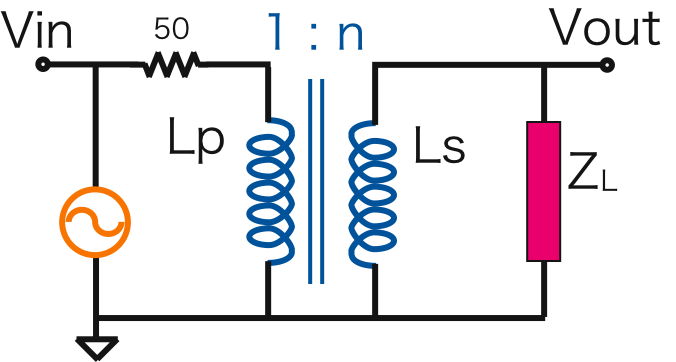
The principle of impedance matching with a transformer is explained as follower. At first consider the simple case, a transformer with a load impedance ZL. The figure below shows a schematic of the circuit.
In the figure above, Lp represents the inductance of the primary coil, and Ls represents that of the secondary coil. Generally signal sources have an output impedance, which is 50 Ohm in this case.
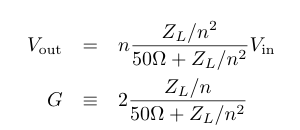
One of the most important roles of transformers is to change the impedance. For example the load impedance looks reduced by 1/n2 if we look at the impedance from the primary coil side. Thus the source voltage Vin will be shared by 50 Ohm and reduced load impedance ZL/n2 in series, then the output voltage Vout will be expressed by
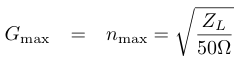
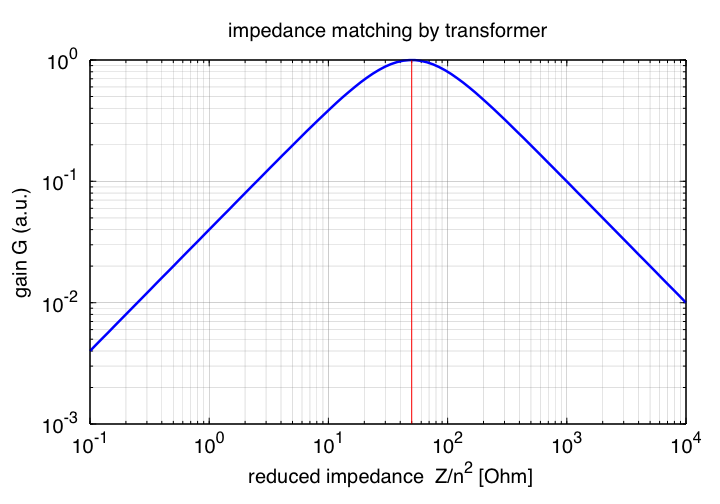
Note that the coefficient n directly indicates the step-up gain. The total gain G reaches its maximum when the impedances are matched. Namely,
- is the condition of the impedance matching. In this case the maximum gain is described as;
- In summary the things we should say about the gain and the impedance matching are
- in order to maximize the gain, impedance matching is required
- under the impedance matched condition, we can increase the gain by increasing the load impedance.
- Those are the reasons why impedance matching is so important. Moreover there are another merits in impedance matching. An impedance matched system can avoid reflections of signals, which can be harmful for some circuits, and avoid standing waves, which make behavior of the circuits nonlinear and more complicated.

2.2 LC resonant circuit
In this section we review a LC resonant circuit because the multi-resonant circuit can be essentially considered as the set of the LC resonant circuit. Now consider the circuit with an inductor L and a capacitor C sitting in parallel.
- The circuit resonates when the angular frequency is
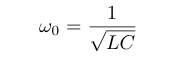 ,
,
- when the denominator goes to zero. An interesting thing will be found if you look at the impedance in frequency-impedance domain (like a bode plot).
There are two solid line, one with f1 dependence represents impedance of L, the other solid line with f-1 represents that of C. Then a resonance occurs at the frequency point where those two lines are crossing.
According to the equation above, the resonant impedance goes to infinity thanks to have a pure imaginary number. However if impedance of L and C have an extra real part, the cancellation does not complete and eventually the resonant impedance is no longer infinite.



2.3 Loss
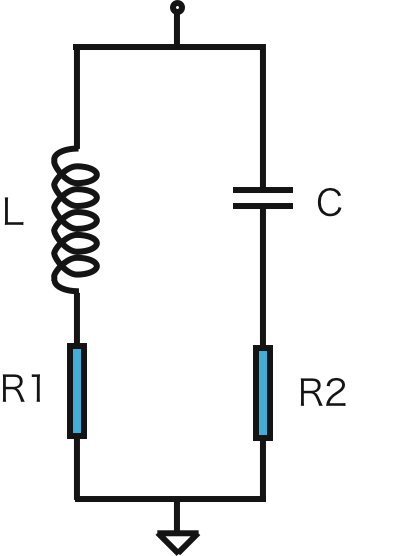
At first let's think about a parallel LC circuit. In the ideal case, where no losses, impedance can go up infinitely at its resonant frequency. However in the real circuit Zres has a finite number. The one of the component which makes Zres lower is the loss. Thus we have to think about the effect of loss toward the Zres. Begin with a simple model shown in fig.2, parallel LC resonant circuit with a DC resistance in serial to L and C.
- In this case the impedance of this circuit is expressed as;
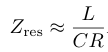
Where R1 and R2 is the loss of the inductor and the capacitor respectively. At the resonance the impedance can be approximately described as;
Here R represents the sum of each loss, namely R=R1+R2.
From this relation we can find the following general prescriptions to make a high Zres.
- bigger L
- smaller C
- smaller loss
- These are the general recipe for making a good (high impedance) resonant circuit.

3. Study of Single resonant circuit
- In order to understand how the circuit works and how losses affects, we started with a single resonant circuit. The circuit is composed by L, C and a transformer in parallel to each other.
3.1 EOM
- One of the key components in the circuit is the EOM, which can be dealt as a capacitor electrically. The EOM also has a series resistance acting as a loss. In the design phase we have to take care about this fact.
- This plot shows the measured impedance of the EOM (New focus 4064 broadband KTP). Below 50MHz the impedance is dominated by the capacitance of the EOM and the capacitance of 17[pF] was found from the measurement. The loss is the resistance of 4 Ohm, which can be easily found at the valley of the impedance.
- The amount of the loss in the EOM is relatively big, because the typical loss in an inductor and a capacitor are less than 1 Ohm roughly. Therefore the maximum load impedance at the resonance will be mainly limited by the loss in the EOM.
- the EOM has the loss of 4 Ohm
- the maximum peak impedance of the circuit will be mainly limited by the loss in the EOM

3.2 design
3.2.1 input impedance and leakage inductace
- The input impedance of the resonant circuit should be 50 Ohm at desired frequency, otherwise the gain will be decreased. Related to this topics, there is one more thing to take care of. That is the effect from leakage inductance onto the input impedance. If the leakage inductance is larger than the 50 Ohm at the resonant frequency, the leakage inductance will dominate the input impedance and finally degrades the gain.
- The below shows the equivalent circuit of a transformer with the leakage inductance.
Where Le is the leakage inductance and M is the mutual inductance. These are related with the primary (secondary) coil via the coupling coefficient k as (1-k)Ls=Le and M=kLs. In typical transformer k is almost unity like ~ 0.995. The load impedance ZL now appears with reduction by 1/n2. The transformer behind the circuit is the ideal transformer, which only steps up the voltage. Usually M has a much larger impedance than the others, so that we can neglect M as an open. Then the input impedance of this circuit should be
At the resonant frequency, ZL/n2 is adjusted to 50 Ohm. However this adjusted impedance will be disturbed by the leakage inductance. So that the requirement for avoiding the effect of the leakages is expressed as;
If we put the resonant frequency of 55MHz, Le needs to be less than 72nH. Then assuming the k=0.999, the inductance of the primary coil must be less than 72uH. For summary
- the inductance of the primary coil must be less than 72uH



3.2.2 choice of LC combination
- Here the question is; How big inductance and capacitance should be used for the circuit component ? There are many choice for making the peak impedance at a desired frequency, because the resonant frequency is determined by the two parameters ( recall omega=1/sqrt(LC)). For the good choice, the impedance should be lager then the other choice of LC combination. The peak impedance is expressed as L/CR, then for the capacitance the minimum value should be chosen. And now the minimum capacitance in the circuit is the EOM whose capacitance is 17pF. This means that we don't need any capacitors except for the EOM.
Now we aim the resonant frequency of 55MHz, which is the most difficult to make high impedance in our set of modulation frequencies (11, 29, 55MHz). Then the inductance L must be 490nH and the resultant peak impedance should be L/CR=7200 Ohm.
- Only the EOM is required for the capacitance in order to minimize the C
3.3.3 electrical performance
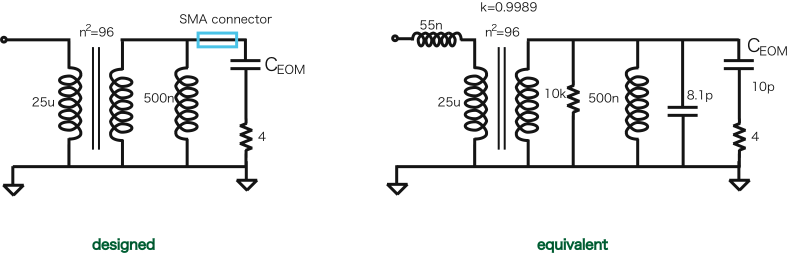
- The below show the schematic of the single resonant circuit that we made. The left figure represents the designed circuit and the right figure represents the equivalent circuit. The EOM and the circuit is connected with a SMA I-connector whose length is about 30mm.
- There are the stray components in the equivalent circuit, we found the DC resistance of 10kOhm and capacitance of 8pF in parallel to the circuit. Also the leakage inductance of 55nH has been found in the input.
Actually there is a story to obtain the squared turn ratio of n2= 96. After inserting the transformer whose squared turn ratio is 16, the resistance of 10kOhm in the transformer was found. This resistance can decrease the peak impedance of the LC circuit and in fact the peak impedance got reduced to 4800 Ohm, which was expected to have 7200 Ohm in the design. Then another two transformer was added in front of this transformer in order to match the input impedance. These two transformers have the squared turn ratio of 1.5 and 4 respectively. In total the squared turn ratio is 16x4x1.5=96 effectively and the input impedance should be (4800 Ohm)/96=50 Ohm at the resonant frequency.
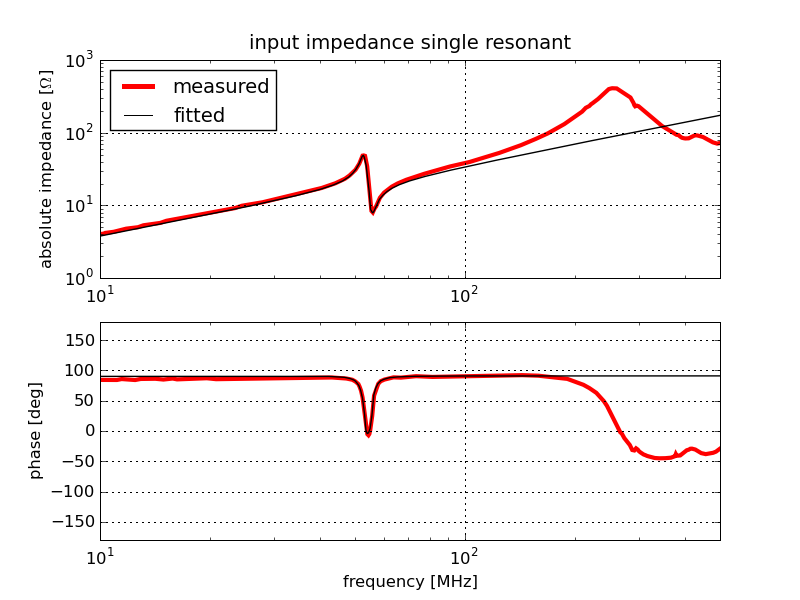
- The measured result of the input impedance is shown below.
- The peak impedance around 50MHz is the resonance and is nicely adjusted to 50 Ohm. The yield resonant frequency is 53MHz. The leakage inductance of 55nH was found by fitting the data, this corresponds to the coupling constant k=0.9989. The thing we found along this measurement is that the capacitance of the EOM looks changed. The capacitance is now 18pF whose value was 17pF in the direct impedance measurement. One of the possible reason is the effect of the stray capacitor, although we can not separately measure them.
3.3 optical test
3.3.1 setup
The optical test have been done by using the optical spectrum analyzer and the signal generator FLUKE 6061A. The details of setup are well explained in Stephanie's document.
- background subtraction
- The point we should do in the phase of the data analysis is the subtraction of the background. The optical spectrum analyzer have a background floor when the incident beam is completely shut out. In order to calibrate this, first we shut out the incident beam with a block, then measure the floor level in terms of voltage. Then remove the block and perform the measurement. After that we can subtract the background voltage from taken data.
3.3.2 frequency response
- The frequency response have been examined by changing the excitation frequency of the signal into the EOM circuit. The drive voltage is 2Vrms (19dBm). In this case the half of the voltage (e.g. 1Vrms) will be transferred to the circuit when the impedance of the circuit is matched to 50 Ohm exactly.
- The expected performance can be derived based on the model, which directly calculated from the measured impedance. The modulation depth as a function of the frequency is expressed as follows.
Where the first term "e" is the modulation efficiency of the KTP crystal we use. In our model e=13mrad is assumed according to the data sheet. Rho represents the reflection coefficient, n is the turn ratio, Vs is the voltage injected from the signal generator. The second term square rooted represents the effect of the mismatch loss, in other words this corresponds to the transmittance of the voltage from the generator to the EOM.
The input impedance of the circuit should be 50 Ohm around the resonant frequency, thus the transmittance becomes close to unity. Then the circuit can obtain the half of the injected voltage. After getting the half of the voltage, the transformer simultaneously step up the voltage by sqrt(n) so that the EO crystal should have 0.5Vssqrt(n). Finally the modulation depth should be 0.5eVssqrt(n). In our case where n=96, Vs=2.8V(=2.0Vrms) and e=0.013, the available modulation depth is expected to 180mrad in the theory.
- Here is the resultant plot.
There is a difference between the expected and the measured curve by a factor of 0.92 in the entire region where we have measured. One possible reason is that it comes from some losses in the circuit. If we add an unknown loss of 0.72dB into this circuit, the resultant data and the model can show acceptable agreement with a few percent discrepancy. Note that the model already includes the insertion loss of the transformers, it is expected to 1.2dB according to the data sheet.


3.3.3 linearity
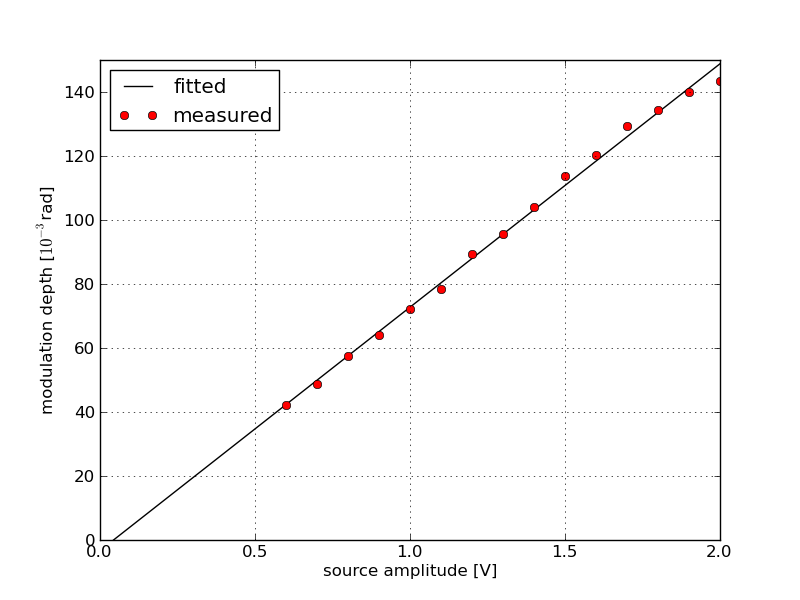
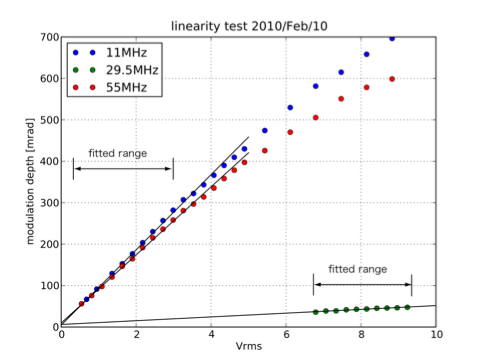
The linearity of the modulation depth as a function of the input excitation voltage have been tested. In this measurement the data has been taken by changing the amplitude of the excitation voltage onto the EOM circuit. The resultant plot is shown below. It shows linear dependency and it is fitted by a function of 76.07038mrad Vs-3.317712.
3.4 conclusion
- The performance of the single resonant EOM circuit have been tested from the view of both electrical and optical. All the yield data can be explained with the model and show acceptable agreements successfully. However especially in the optical test, there is a difference between the expected and the measured modulation depth by a factor of 0.92. One possible reason is the effect of an unknown loss, however right now we don't have clear explain for this discrepancy.
4. multiply resonant circuit
4.1 what's difference from single-resonance ?
- Here we consider the difference between multi-resonant and single-resonant. This
4.2 design
- The requirements for the multiply-resonant circuit are follower;


4.3 performance test
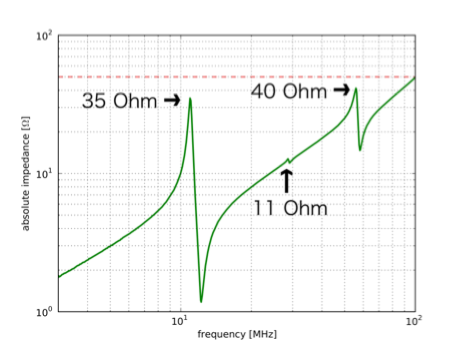
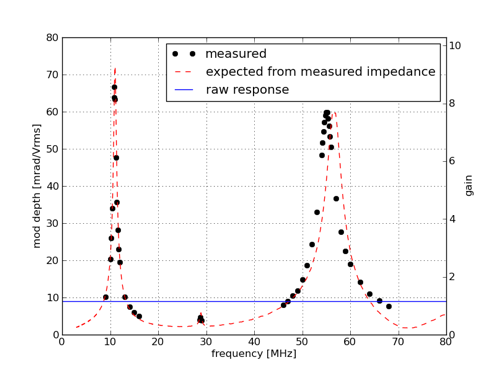
- Here we will report the resultant performance of the circuit both in electrical and optical test.
- As we expected....
4.4 conclusion
- We have developed the multiply resonant circuit, which.....
5. Final design and Installation
5.0 Design
- A summary of the design can be found in the attached pdf
5.1 Reduction of RF reflection
- An RF reflection is quite problematic because :
- it could damage the RF source.
- it can creates unwanted standing waves in coax cables.
- the standing wave could potentially distort the wave and results in non-negligible amount of higher harmonics
- In order to avoid the RF reflection there are several ways. The most standard method is impedance matching but it turned out it will be challenging since there are three certain frequencies, where the impedance matching are needed. Another way to eliminate the reflection is to utilize an RF amplifier, which works as an buffer.
- Here we decide to use an RF amplifier for reduction of unwanted RF reflections. When an RF amplifier is used one has to pay attention about the following things :
- Cable length in order not to have
- Current consumed in the amp
- Reverse isolation
5.2 Design of the circuit in PCB
- Requirements :
- As compact as possible such that the circuit behaves as a lumped element circuit.
- Strip line ?
- Variable inductors
 it will be done soon
5.3 Design of the box and mounts
- Requirements :
- The cable must be as short as possible
it will be done soon
5.4 Item information
Status
item
part number
vendor
Price/each
Qty.
Price
in hands
RF transformer kit
Coilcraft
2
selecting
High-Q MLC capacitors kit
in hands
Variable inductor kit
1
ordered
RF amplifier
A2CP2596
Teledyne Couger
-
2
-
selecting
Heat sink
2
designing
PCB board
3
selecting
box
RB22
Serpac
3
selecting
radiation shield
40-CBS
Leader Tech
3
selecting
SMA feedthru
901-9184-CCSF
Amphenol
3
selecting
SMA feedthru
72962
Pomona
6
selecting
SMA feedthru
13_SMA-50-0-2/111_NE
Hurber+Suhner
3
Cougar RF amp.
- Specifications and ducuments
5.5 Installation
- A picture will be uploaded
A. impedance measurement
- In this chapter the technique for measuring the impedance by using Network Analyzer (Agilent AG4395A) is explained.
A.1 voltage dividing technique
- Network analyzer is the apparatus basically measure the RF power. In order to measure the impedance of a sample a trick is needed. One of the easy way is that based on the principle of voltage dividing. For example
A.2 impedance test kit
In order to crosscheck the measured impedance data, we took the same data by using a different configuration. We have usually taken the data by using voltage dividing technique described above. Another way to measure the impedance is using AG4395A with the extension kit A4016. This extension kit allows us to directly observe impedance typically from 10-2-106 Ohm. The figure shown below is the comparison of results which taken using these two different configuration. The resonant frequency differs about 10%, it might cause by parasitic capacitor of lead inductance. The significant point is that those two Zres show good agreement within 5% difference.

A.3 mismatch loss
In the RF domain, usually the reflection of the signal leads to some critical problems. One of the biggest effects is the mismatch loss. This directly comes from the mismatch of the impedance. Consider following example situation; a signal generator with the output impedance of 50 Ohm is driving a load composed by a circuit and an EOM.
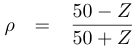
- In this case the reflection of the signal will occur at the impedance discontinuity point (black dot in the figure above). The reflection coefficient for the voltage of the signal is defined as;
Where Z represents the input impedance of the load composed by the circuit and the EOM. Because of this, a part of the generated voltage will be reflected while another part can go through. Thus the reflection can reduce the RF power transferred to EOM. The reflection will be maximized when input impedance Z is opened or shorted, and it will be completely vanished when the Z=50Ohm. This is the principle of the mismatch loss ( also known as return loss).
- input impedance of the circuit should be close to 50 Ohm in order to minimize the mismatch loss

B. calibration of modulation efficiency
- The modulation efficiency of raw EOM has been examined by using optical spectrum analyzer. In this calibration we indirectly measure the voltage crossing the EOM by using oscilloscope with the input impedance of 50 Ohm. The 50 Ohm termination was connected to the EOM in parallel in order to apply the same voltage as that of the oscilloscope. The setup is shown below.
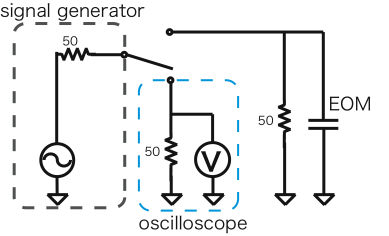
. In fact the signal generator can not sufficiently drive the EOM to see the sideband with the optical spectrum analyzer. Therefore we inserted the RF amplifier whose output was also calibrated by the oscilloscope.
The modulation efficiency of the EOM is 11.4mrad/Vrms
Referenced and Documents
Cougar RF amp.
- Specifications and ducuments