
Multiply Resonant EOM
Introduction
EOM (Electro-Optic Modulator) is a device to modulate the phase/polarization of a laser beam by an electric voltage signal. (http://www.rp-photonics.com/electro_optic_modulators.html) The main use of EOMs in LIGO is to add phase modulation sidebands to the main laser beam. Those sidebands are necessary to extract the information of the positions and orientations of the mirrors. For the advanced LIGO style length sensing scheme, we need two + one sidebands (i.e. three). The first two are used for the length and alignment sensing of the main interferometer. The last one is used for controlling the mode cleaner. The goal of this project is to design, build and test the double or triple resonant circuit to use with an EOM so that we can apply phase modulations at multiple frequencies with one EOM crystal.
Basic ideas
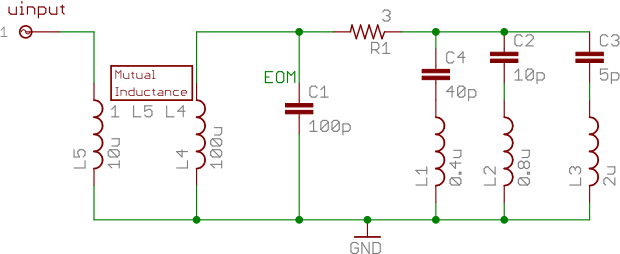
An EOM can be regarded as a capacitor in an electric circuit. Therefore, we can form a resonant circuit by combining it with inductances. An example of triple resonant circuit is shown below. At resonances, the impedance across C1 becomes large. Using a transformer (indicated by L5 and L4 in the schematic), we can convert this impedance to 50 Ohm (to match the impedance of the RF signal source). The transformer will also amplify the voltage across the EOM by the ratio of the primary and secondary coils' number of windings. Therefore, we can apply a high voltage on the EOM with a relatively small driving signal.
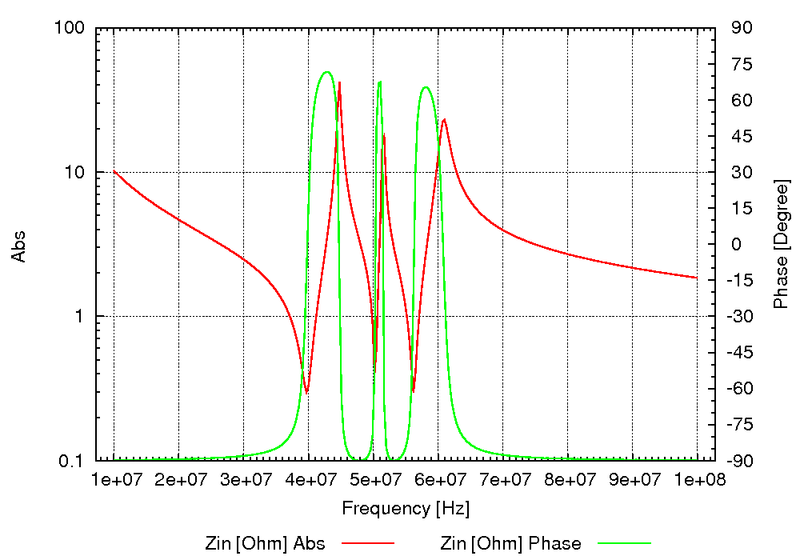
A circuit simulation shows the input impedance of the above circuit has peaks at three frequencies.
Project steps
We will start from finding an appropriate circuit configuration. The above example is probably too naive.
Optimization of the circuit parameters will be the next step. We want to make sure that all the resonances have roughly the same impedance.
Then we will design and make a circuit. Setup a test optical system and test the performance.
Theoretical analysis and experimental confirmation of inter modulations between the sidebands may be also interesting.
EOM Circuit Specifications
- Resonance at 11 MHz, 29.5 MHz, and 55 MHz
- Optical modulation depth should be 0.1 rad; since the modulation efficiency of the EOM is 13 mrad/V, this corresponds to a voltage of ~10V (this will depend on both the EOM circuit and the driving voltage)
- Impedance (seen by source) should be 50 Ohms at each resonant frequency
- Voltage across EOM should be roughly the same at all resonant frequencies
- Using New Focus EOM KTP 4064 (C = 5-10 pF)
RF Signal Generation
The best possibility is to use a frequency generator (or crystal oscillator) and a multiplier.
The basic idea is contained in this document RFOscillatorForThe40mUpgrade.ppt .
Designing the Frequency Generator
The frequency multiplier, for the way it works, will inevitably introduce some unwanted harmonics into the signals. These will show up as extra modulation frequencies in the EOM.
In order to quantify the effects of such unwanted harmonics on the interferometer and thus to let us set some limits on their amplitude, we can run some simulations with Optickle. The way the EOM is represented in Optickle is by three RF modulators in series. In order to introduce the unwanted harmonics, I just added an RF modulator in series for each of them. I also made sure not to leave any space in between the modulators, so not to introduce phase shifts.
To check the effect at DC we can look at the sensing matrix and at the error signals. For example, we can consider the 3f error signals that we plan to use for the short DOFs and looked at how they depend on the CARM offset. The simulations can be repeated for several possible amplitude of the unwanted harmonics. Some results are shown in the plots in ErrorSignalsWithRFoddHarmonics.PDF. 'ga' is the amplitude ratio of the unwanted harmonics relative to the amplitude of the 11 & 55 MHz modulations.
Comparing to the case where there are no unwanted harmonics (ga = 0), one can see that not considerable effect on the error signals for amplitudes 40dB smaller than that of the main sidebands. Above that value, the REFL31I signals, that we're going to use to control PRCL, will start to be distorted: gain and linearity range change.
So 40 dB of attenuation in the unwanted harmonics is probably the minimum requirement on the frequency multiplier, although 60dB would provide a safer margin.
Second Progress Report
Due with final abstract: Monday, August 3 at 5 pm ProgressReport2_FinalVersion.pdf
Final Talk
Wednesday, August 19, 2009
Powerpoint: FinalTalk_090818.ppt
PDF: FinalTalk_090818.pdf
Final Paper
Due Friday, September 25 at 5 pm (Uploaded to SFP Website)
Draft (as of 9/24): FinalPaper_090924.pdf