
Hall Sensors
A Hall sensor uses the Hall effect to measurement the distance between the sensor and a magnetic object. When the position changes, the magnetic flux picked up by the sensor changes, which in turn modifies the output voltage of the sensor.
In the first stage experiment, we have used the sensors produced by Allegro http://www.allegromicro.com/en/index.asp. In particular, we tested the A1322 model. It has a good linearity and wide detection band. The problem we find with such sensor is that the undesired coupling between the coil and the sensor. Basically, the sensor not only picks up the field changes induced by the magnet and also the one created by the coil. In certain frequency, those two signals destructively interfere with each other and create a dip in the open-loop transfer function of the feedback system, as shown by the figure below. We have added more details in the 40m elog.
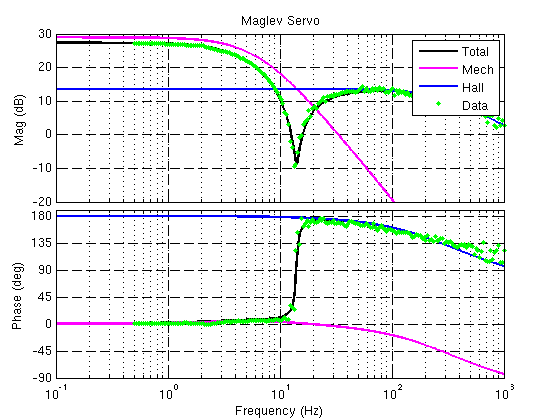
In this figure, the green dots denote the measurement data of the open-loop transfer function of the feedback control loop. The Black curve is the simulink model of the system with magenta and blue curves denoting the contribution from mechanical and hall sensor respectively.
Inductive sensor
A typical inductive sensor is the eddy-current sensor. The sensor creates alternating magnetic field and it induces eddy currents inside the conductive target, which in turn modulates the magnetic field and it gets detected by the sensor.
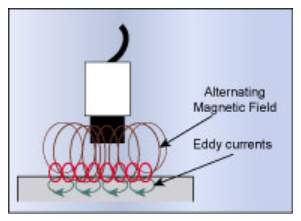
This figure is from the webpage of lion precision http://www.lionprecision.com/inductive-sensors/index.html, which produces such kind of sensor.
The limitation of such sensor is that it requires the sensing objects to be conductive. In addition, since it is sensitive to the change in the ambient magnetic field, such device would has a similar problem as the hall sensor, due to the coupling between the sensor and the control coil.
Capacitive Displacement Sensors
A capacitive displacement sensor probes the position between the target and the sensor by measuring the capacitance. Generally, it requires the sensing object to be conductive such that when alternative voltage is applied between the target and the sensor, the induced currents give the information about the target location. If the object is non-conductive, the position will still be able to be probed by measuring the so-called fringing fields. Basically, when the object is present, it changes the dialectic property of the environment which modifies the electric field. If the sensor has an inner core and outer layer as shown schematically in the figure below, the capacitance between the core and the outlay can be measured which tells the position of the non-conductive object.
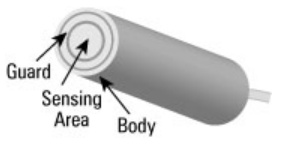

There is a good introduction of such capacitive sensor on the lion precision webpage. http://www.lionprecision.com/tech-library/technotes/cap-0020-sensor-theory.html#capmeas
The detection range of such sensor ranges from several µm to cm. Depending on the detection bandwidth, the typical peak-to-peak voltage fluctuation is around 0.002 V for 10V/mm sensitivity, which corresponds to a error of 0.2µm. This quantity doesn't tell anything about the noise spectrum, and we can test it if necessary.
One immediate advantage of capacitive sensor is that there is no coupling between the coil and the sensor which plagues the use of Hall sensor. Another advantage is that it is very compact with a probe size of 5mm x 8mm x 1cm, which can be easily fitted into the experimental setup.
OSEMs
This OSEM type of shadow sensor has already been used in sensing the position of LIGO test mass. It consists of a LED and a photodiode. A small flag is attached to the target which will modulate the optical power on the photodiode by blocking part of the light when the target moves.
Such sensor can have a very good displacement sensitivity. As measured by the group in University of Strathclyde at Glasgow, the sensitivity of LIGO hybrid OSEM type of shadow-sensor can achieve a sensitivity of 10-10m/rtHz.
We are now trying to use this type of sensor in the experiment.
Interferometer
Another appealing option would be an interferometer based on fibre optics. Its principle is well known, and there is a good introduction to this kind of sensor: http://physics-animations.com/sensors/English/interf.htm
The basic setup is shown schematically by the figure below:
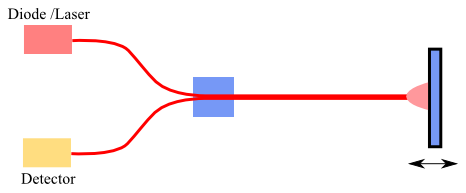
The light that reflects from the end of the fibre and the object surface interferes with each other and modulates the optical field which is detected by a photodetector. If the object is coated, the fibre end and the object surface can form a Fabry-Perot cavity which can significantly increase the displacement sensitivity. This type of sensor is also easy to incorporate into the suspension scheme. We can test it in the future experiment.