We measured the voltage fluctuation of the Hall-effect sensor, from which we infer the displacement sensitivity given the suspended magnet we used. The circuit for this experiment is shown in the following figure, which is a simple high-pass filtering of the sensor output.

The corresponding transfer function of the filter is shown below. It has a corner frequency around 0.1 Hz.

Noise Spectrum
The raw data from the spectrum analyzer by measuring different frequency bands are shown in the figure below.
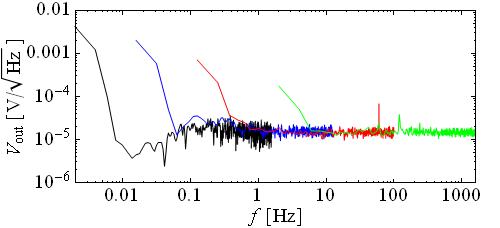
By normalizing with respect to the high-pass transfer function and piecing different frequency bands together, we obtain the entire spectrum from 0.005 Hz to 1600 Hz of the voltage fluctuation in the Hall-effect sensor. As we can see that the noise spectrum is almost flat from low frequencies to high frequencies.

Rate of change of the magnetic field

If we assume that the transfer function between the voltage output of the Hall-sensor and the magnetic field strength is frequency independent, we can easily obtain the corresponding noise spectrum for the field strength. This in turn gives the displacement sensitivity of the hall sensor if we know the rate of change of the magnetic field.
The suspended magnet we will use in the prototype is half inch in diameter and 1/8 inch in thickness as shown. We performed a single measurement of its magnetic field strength along the axial axis with a similar setup of the calibration measurement. The data and the corresponding numerical fit is shown below. The horizontal axis is the distance between the Gauss meter sensor and the magnet.

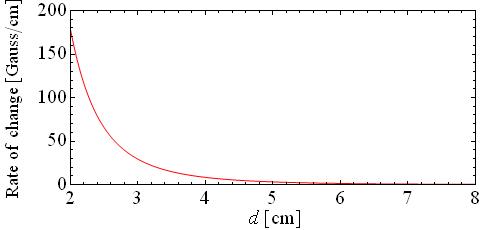
The magnetic field changes when the position of the magnet changes. The derivative of the field strength with respect to distance, i.e., the rate of change, is shown by the figure below.
Displacement sensitivity
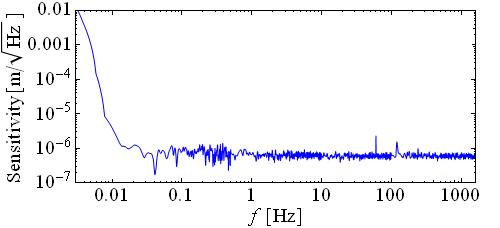
Suppose the distance between the magnet and the Hall-effect sensor is around 2.5 cm, and the corresponding rate is 49 Gauss/cm from the above figure. From the previous calibration result, we know that the output voltage changes as 3.8 mV/Guass. These two give the following displacement sensitivity of the Hall-effect sensor. It is around 10-6 m/Hz1/2 from 0.01 Hz to 1600 Hz.