
We used the LakeShore Model 410 Gaussmeter to calibrate the Allegro A1323 Hall-effect sensor by measuring the magnetic field as a function of the gap between the sensor and a cylinder NdFeB magnet. The schematic plot of the experiment is shown by the following figure.

Measurement data of Gauss meter
We measured seven different positions with each performed for three times. The data are listed in the following table.
d [cm] |
B [Gauss] data 1 |
B [Gauss] data 2 |
B [Gauss] data 3 |
Mean [Gauss] |
Standard deviation [Gauss] |
0.90 |
68.9 |
69.7 |
68.6 |
69.0 |
0.570 |
1.10 |
46.1 |
44.7 |
43.8 |
44.9 |
1.16 |
1.40 |
26.1 |
26.5 |
26.2 |
26.3 |
0.210 |
1.70 |
17.5 |
17.4 |
17.5 |
17.5 |
0.060 |
1.90 |
13.2 |
12.8 |
13.5 |
13.2 |
0.350 |
2.10 |
10.2 |
10.5 |
10.4 |
10.4 |
0.150 |
2.40 |
6.70 |
6.80 |
7.90 |
6.8 |
0.660 |
The data and the corresponding numerical fit is shown by the following figure.
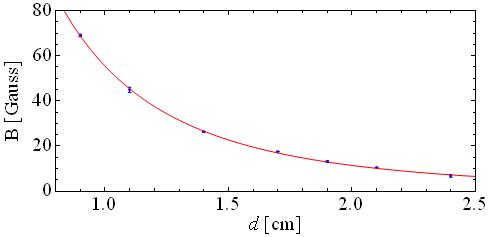
The analytical function that fits the measurement results is given by
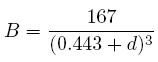
This exactly recovers the scaling of the magnetic field for a dipole (a good approximation for a cylinder magnet). The additional factor 0.443 in the denominator comes from the difference between d and the actual distance from the center of the magnet to the sensor.
Measurement data of Hall-effect sensor
We preformed similar measurements for the Hall-effect sensor.
d [cm] |
δVout* [Volt] data 1 |
δVout [Volt] data 2 |
δVout [Volt] data 3 |
Mean [Volt] |
Standard deviation [Volt] |
0.90 |
0.184 |
0.175 |
0.174 |
0.178 |
0.00550 |
1.10 |
0.132 |
0.117 |
0.115 |
0.121 |
0.00929 |
1.40 |
0.0700 |
0.0690 |
0.0700 |
0.0700 |
0.000600 |
1.80 |
0.0440 |
0.0450 |
0.0450 |
0.0450 |
0.000600 |
1.90 |
0.0350 |
0.0350 |
0.0350 |
0.0350 |
0.000 |
2.10 |
0.0280 |
0.0280 |
0.0270 |
0.0280 |
0.000600 |
2.40 |
0.0200 |
0.0210 |
0.0200 |
0.0200 |
0.000600 |
*δVout=Vout-Vout(B=0)
Vout(B=0)=2.50 Volt in the experiment.
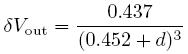
The data and the corresponding numerical fit is shown by the figure below.

The function that fits the measurement data is simply
Calibration
From the above results, we find out that the output voltage of the Hall-effect sensor changes as approximately 3.80 mV/Gauss, if we assume that the Gauss meter provides the correct standard. For future experiments, the uncertainty of this ratio will not affect the feedback performance, as long as the sensor is working within its linear dynamic range.