|
Size: 1272
Comment:
|
Size: 1495
Comment:
|
| Deletions are marked like this. | Additions are marked like this. |
| Line 23: | Line 23: |
| For comparison, this means that our reference cavity has a sensitivity to vertical acceleration of 38 kHz/(m/s^2). The Ye/Hall vertical football cavities have a sensitivity of 10-20 kHz/(m/s^2). Not such a big difference. |
We have done some analysis of the Reference Cavity using COMSOL. We got the design parameters for the reference cavity from [http://www.ligo.caltech.edu/docs/D/D980670-00.pdf D980670]
Basic Model Parameters
T = 273 + 38 K (reference cavity can is kept at 38 C)
- Spacer and mirrors made of Corning Fused Silica (7940) - in reality its probably 7980?
Uses: Structural Mechanics module, Heat Transfer module, & Materials Library
Eigenmodes
- Remove gravity
- No constraints (as if there's no wire)
Vertical Sensitivity
- Constrain the grooves on the bottom in all 3 DOF.
- Add a load force on the spacer. F/V = -9.81 * 2200 (comsol likes a force/volume)
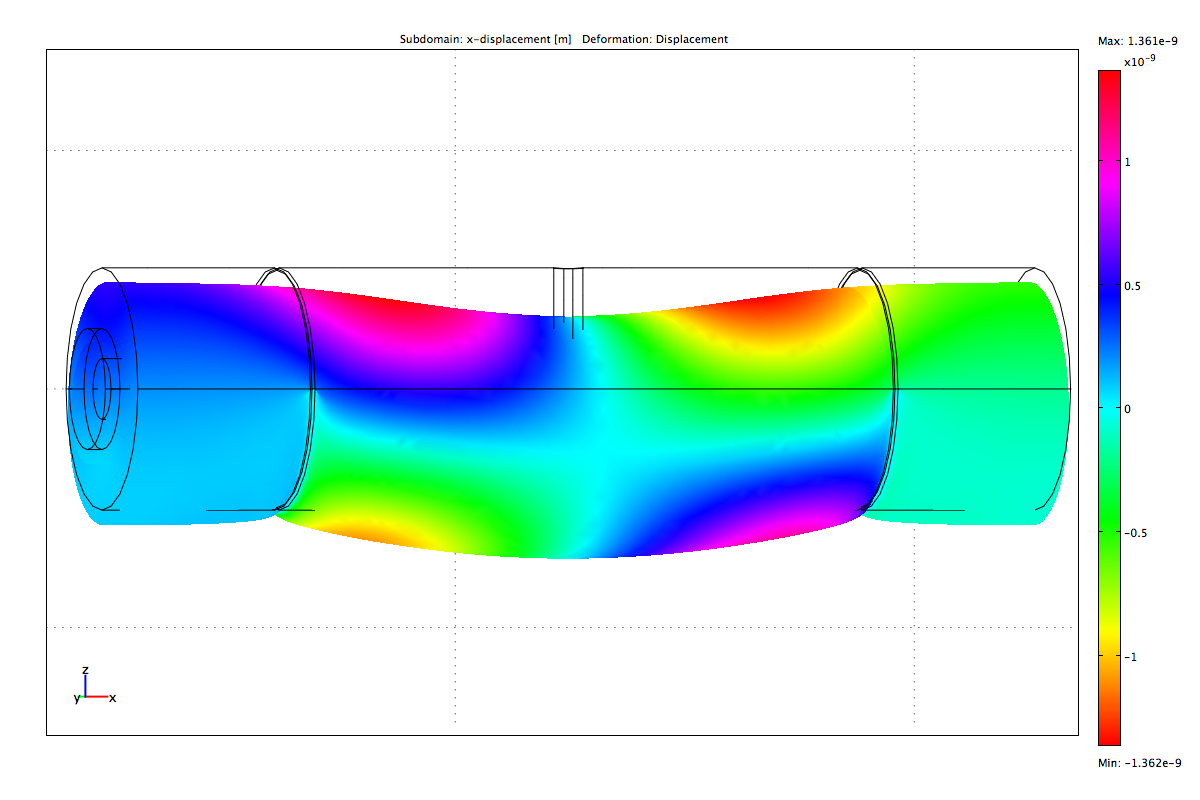
Deformation of the cylinder shows the actual shape. Color indicates displacement along the cavity axis.
The displacement of the left mirror is ~0.2 nm. So the sensitivity of the cavity length to vertical acceleration is 4 x 10^-10 (dL/L) / g. Next we have to consider the limited vibration isolation characteristics of the reference cavities stack and spring pendulum.
For comparison, this means that our reference cavity has a sensitivity to vertical acceleration of 38 kHz/(m/s2). The Ye/Hall vertical football cavities have a sensitivity of 10-20 kHz/(m/s2). Not such a big difference.