
We have done some analysis of the Reference Cavity using COMSOL. We got the design parameters for the reference cavity from D980670
Basic Model Parameters
T = 273 + 38 K (reference cavity can is kept at 38 C)
- Spacer and mirrors made of Corning Fused Silica (7940) - in reality its probably 7980?
Uses: Structural Mechanics module, Heat Transfer module, & Materials Library
Eigenmodes
- Remove gravity
- No constraints (as if there's no wire)
Vertical Sensitivity
- Constrain the grooves on the bottom in all 3 DOF.
- Add a load force on the spacer. F/V = -9.81 * 2200 (comsol likes a force/volume)
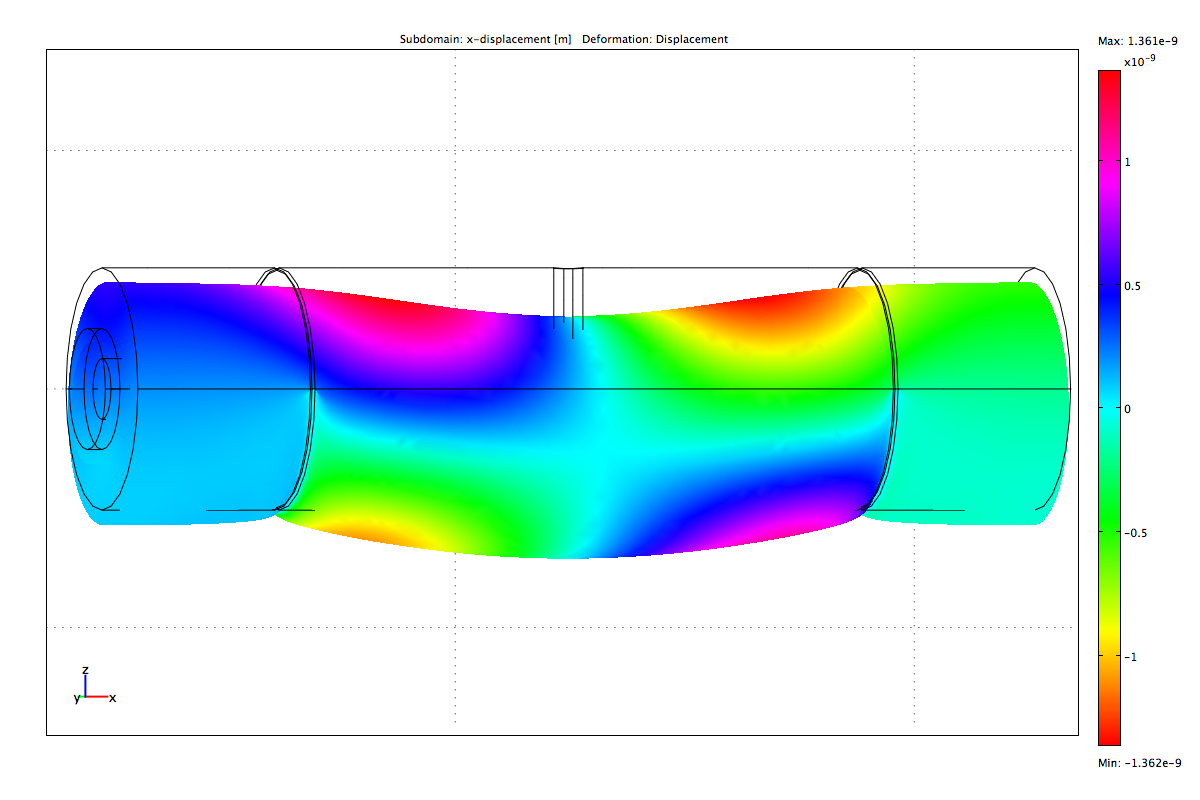
Deformation of the cylinder shows the actual shape. Color indicates displacement along the cavity axis.
The displacement of the left mirror is ~0.17 nm. The overall cavity length gets shorter by ~0.35 nm making a strain of dL/L = (3.5e-10)/0.20 = 1.7 x 10⁻⁹. So the sensitivity of the cavity length to vertical acceleration is ~2 x 10⁻¹⁰ / (m/s2) or 53 kHz / (m/s2). Next we have to consider the limited vibration isolation characteristics of the reference cavities stack and spring pendulum.
For comparison, the Ye/Hall vertical football cavities have a sensitivity of 10-20 kHz/(m/s2). Not such a big difference if it turns out that the measured sensitivity is as good as the model.


The sensitivity of the cavity to /Horizontal_Accelerations (beamline (X) and non-beamline (Y)) are much smaller than the vertical direction.
Thermal Noise
Temperature Noise
The reference cavity's vacuum can is actively stabilized with a PID loop of ?? Hz BW. Is it an integrator?
The sensor noise of the AD590 temperature sensors is 40 pA/rHz (according to the data sheet) which corresponds to 40 uK/rHz. If were able to stabilize to this level (which I doubt), the inside temperature fluctuations would then be in the 10 nK/rHz regime because of the passive filtering of the can.
IF true, the strain noise of the cavity spacer would be (10 nK/rHz)*(5e-7 (dL/L)/K) = 5e-15 / rHz. This is a LOT more than either the coating thermal noise or seismic noise.
Here's the measured temperature noise at some random room at the AEI tempnoise.pdf. We can assume that the 'ambient' line is typical of a basic room.