
Optical Gyroscopes for Ground Tilt Sensing in Advanced LIGO
Introduction
The low frequency isolation of suspensions for Advanced LIGO will be achieved using seismometers, whose signals are fed forward into active hydraulic units (HEPI). The sensitivity of the seismometers to horizontal displacements is good enough to achieve the required isolation. However at very low frequencies, couplings of rotation or ground tilt, into horizontal seismometer signals, become problematic.
For a horizontal seismometer the ratio of sensitivity to rotation to sensitivity to horizontal motion is given by:
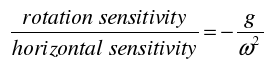
Below some frequency we may expect that the response of the seismometers will become dominated by tilt. By using a rotation sensor in parallel with the seismometers, it will be possible to remove the rotation component of the signal that is fed forward to the active stage.
Laser Gryoscopes
Laser based gyroscopes operate on the sagnac principle ( http://en.wikipedia.org/wiki/Sagnac ) whereby the path length for light travelling round a ring is altered as it rotates. In a sagnac interferometer, beams sent in opposite directions round the rind are interfered at the output, giving a beat frequency that is proportional to the rotation rate. They are commonly used in applications where the requirement is for a small rugged unit capable of measuring relatively large rotation rates. However research is also taking place into more sensitive gyroscopes for geophysical measurements, such as in the following papers:
The systems shown in these papers are ring lasers, where the gain medium is actually within the ring. It is also possible to build a system where the excitation is external to the ring, with the laser being injected into the cavity from outside. This can be seen in the following papers:
external_excitation1.pdf external_excitation2.pdf
We plan to follow a similar route, using a laser external to the cavity. The system will look something like this:
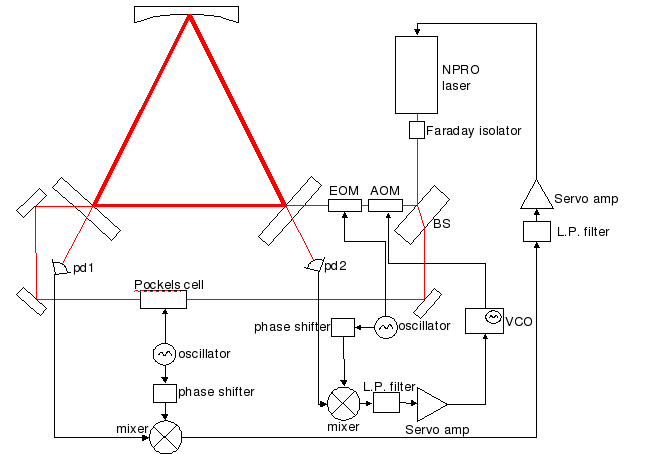
In this diagram, the laser would be locked to the cavity length for the clockwise beam. A Pound-Drever-Hall locking scheme will be used, necessitating sidebands which we put onto the laser beam using an EOM. More about PDH locking can be found here:
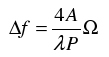
The counter-clockwise beam is locked to the cavity by frequency shifting using AOM. The beat frequency of the two modulation signals is then dependent on rotation rate,  , and is given by:
Useful Reading
Ring Laser Gyro for Tilt Sensing in Virgo++ RomeGyro.pdf
II. Virgo g-Laser gyro. RomeGyro-doc.pdf
Progress Report
Now that I've finally figured out how to get onto the 40m wiki and update this page, I figured I'd give a progress update. My first progress report was turned in yesterday. It is here:
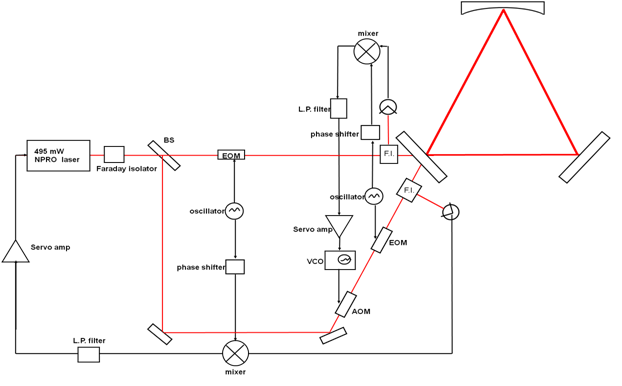
There are a few changes from the initial laser gyro design. Rather than use two partially transmitting mirrors and one highly reflecting mirror in the triangular cavity, there will be two highly reflecting mirrors and one partially transmitting. This will allow a higher finesse to be achieved, which ultimately results in a more stable laser. Both the clockwise and counterclockwise beams will be injected into the partially transmitting mirror, and Faraday Isolators will be used to pick off the returning beams. The setup from there is the same as it was for the previous design: the counterclockwise beam will be locked by acting directly on the laser, and the clockwise beam will be locked to the counterclockwise mode by acting on the AOM. You can see this better in the figure:
Progress Report Part Deux
This has all the same stuff as the original progress report, but with a few things added:
*An Abstract
*Power and Divergence measurements for the 495 mW NPRO
*Intensity Noise measurements of the 495 mW NPRO (this is before it decided to overheat)
*Included with the above is a theoretical derivation of shot noise, and that's plotted on the same charts
*Exploration of how shot noise-limited sensitivity scales with finesse (with all other parameters fixed)
*New photo of the current setup, with components labeled and beam path indicated
Anyways, here it is: