
(Edited by Andrey Rodionov on November 28 - 2007)
The Matlab algorithm for modeling the response of test masses motion/displacement to the ground noise is discussed on this page.
The main idea of this work: find the dependence of the differential length between two mirrors in the arm of interferometer on the values of suspension damping gains for the "input" and "end" test masses in the arms of the interferometer. Minimization of the differential length is an important task, because having minimal differential length means that the force you apply to mirrors forming a cavity to keep the cavity resonating (X-arm, Y-arm or some other cavity) is also minimal.
As the first step of our model, we consider the following simplified situation: (1) Each of the test masses is in reality suspended on a system of two thin wires, but we replace that system of a test mass hanging on two wires to a mathematical pendulum with Q-factor which can be varied as if we are varying the suspension damping gain; the whole pendulum will be described in our treatment in terms of the pendulum transfer function; (2) the above mentioned wires, or the top point of suspension of the mathematical pendulum, is firmly attached to the top of the cage representing the top of the system of stacks which is used for active vibration damping. We will describe the system of stacks in terms of the stack transfer function. See picture for full clarity.
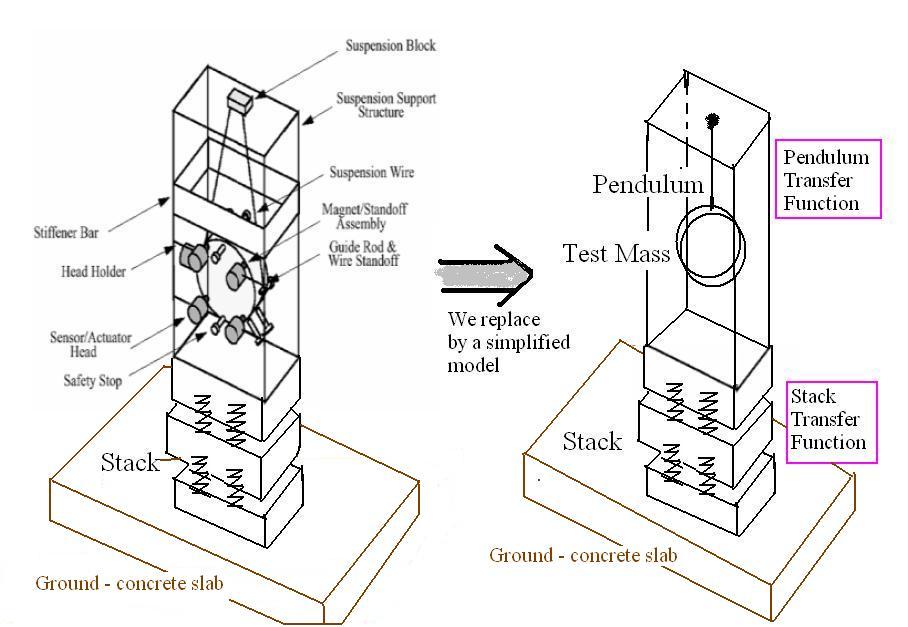
In the attached pdf-file with contains slides from my presentation for LIGO 40-m traditional Wednesday meeting, there are discussions, formulae and plots for the stack transfer function and for the pendulum transfer function. As the input for our system, we use the calibrated measured by accelerometer ground noise displacement data. Multiplying the input ground noise data by two transfer functions, we get the displacement of the test mass in response to the ground noise motion. Calculating such response separately for "input" and "end" test masses, subtracting the two results and taking root-mean-square of the difference, we get the dependence of the differential length on the Q-factors Q_I and Q_E of the input and end pendulums. The three-dimensional graph of such dependence is contained in the attached file.
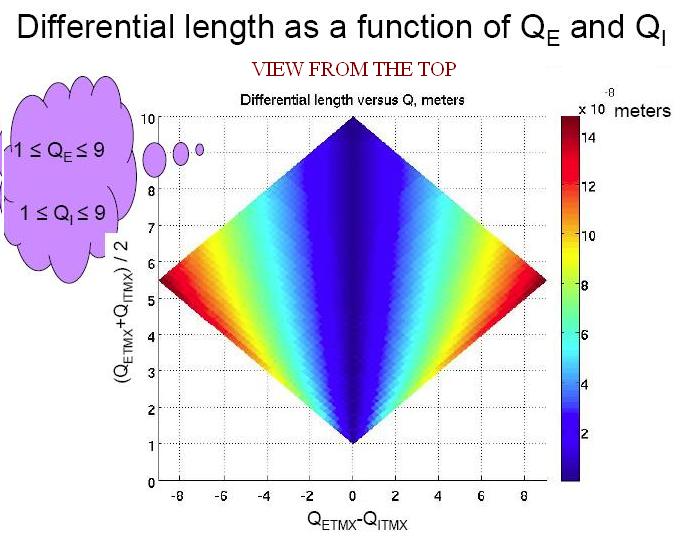
See the attached pdf-file of my presentation at 40-m meeting, made on Wednesday Nov.28 - 2007.