
Recycling Cavity Lengths and Asymmetry
Modulation frequency
The modulation frequency f_mod is 11.065399MHz and its 5 times multiple. They are called f1 and f2, respectively.
- 1*f1 : 11.065399 MHz
- 2*f1 : 22.130798 MHz
- 3*f1 : 33.196197 MHz
- 4*f1 : 44.261596 MHz
- 5*f1 = 1*f2 : 55.326995 MHz
- 10*f1 = 2*f2 : 110.653990 MHz
- 15*f1 = 3*f2 : 165.980985 MHz
Current most reliable cavity lengths as of Apr. 29th, 2011
- Arm Length: 37.7974 [m] (Update as of Apr 10, 2014 : X arm length = 37.79 +/- 0.05 m, Y arm length = 37.81 +/- 0.01 m. Ref. Elog 9804)
- PRC Length: 6.7538 [m]
- SRC Length: 5.39915 [m]
- Asymmetry (lx-ly): 0.0342 [m]
Resonant conditions
The lengths of the recycling cavities are to be designed such that f1 and f2 sidebands are resonant in the interferometer while the carrier fulfills the usual resonant conditions: resonant in the coupled PRC, and antiresonant in the SRC (such that the DARM signals are extracted to the dark port without significant storage in the arms.)
- If we stick on the small asymmetry regime as we do in aLIGO, the f1 sidebands are resonant only in the PRC and has very small leakage to the SRC.
- On the other hand, the f2 sidebands are resonant in the SRC and are made nearly critically coupled to the IFO.
Cavity lengths and Schnupp asymmetry
 These are naive values to be made precise
The PRC length is determined by its FSR that is to be matched with 2 f_mod.
- L_PRC ~ c/(4 f_mod) = 6.77 m
And the SRC length is determined by its 2 FSR that is to be matched with 5 f_mod
- L_SRC ~ c/(5 f_mod) = 5.42 m
The mount of Schnupp asymmetry is determined by the transmittion of f2 sidebands to the dark port.
The transmission in the loss-less model is expressed as the following
- (tp ts sinα)/(1 + rp rs - (rp + rs) cosα)
This is maximized to the unity when α is 0.039.
- dL_MICH: (α c)/(2 π 5 f_mod) = 0.033 m
Effect of arm reflectance
The above calculation can be true if the sidebands are reflected by the arm with a reflectivity with a real number. This happens if the arm cavity lengths are selected such that the sidebands are exactly located on the anti-resonances. However, this does not happen both by practically restrictions and by design reasons: Practically the modulation freq and the arm FSR are not adjusted to have such an exact relationship. Furthermore, we shift the modulation frequencies from the exact anti-resonance as we don't like to resonate any sidebands, including higher-order ones, in the arm cavities.
This induces several issues as followings:
Phase difference of the sidebands in arm reflection
The f1 and f2 sidebands are not resonant but not antiresonant too. Because of this intermediate nonresonance, the arm cavity has different reflectivity for the f1 and f2 sidebands.
(Figure: The phases which sidebands earn at the reflection by the arm. Red: f1 sidebands, Blue f2 sidebands)
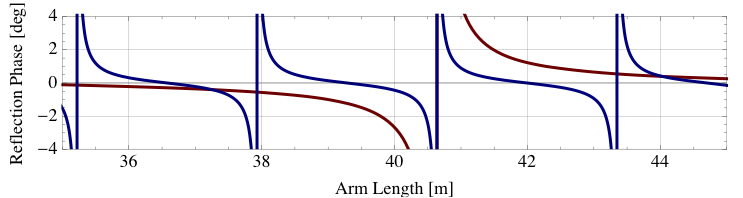
If the sidebands experiences different round-trip-phase in the power recycling caivty, the following effects are induced:
- Those sideband can not be resonant at the same time in the PRC.
- The sidebands get phase shifted by the detuned PRC during the reflection by the Michelson compound mirror.
- The above phase shift is dependent on the Schnupp asymmetry.
Finesse code is here:
Sideband imbalance at POX and POY
Another issue is that the light power at POX and POY become imbalanced. This imbalance is present in the following condition:
- Both PRM and SRM are present.
- Schnupp asymmetry is employed.
- The arm cavities reflects the sidebands with complex reflectivity (i.e. the sidebands are neither resonant nor anti-resonant).
This effect occurs if the arm reflectivity for the sidebands have imaginary part. This is different from the other issue explained above.
This was understood by the coupling of the complex arm reflectivity and the Schnupp asymmetry under the presence of the SRC.
The detail is explained in the attached document.
Simulation code. Use mkat to run this code.
Resolution
The f2 sidebands earn five times phase in the PRC than the f1 sidebands. There for if the f2 sideband earn five times phase at the arm reflection than the f1 sidebands, the PRC (and SRC too) can have the resonance for the f1 and f2 simultaneously.
The figure below is the same plot above except that the f2 phase (Blue) is 1/5 of the original. The arm length where the red and blue curves cross does fulfill the above condition.
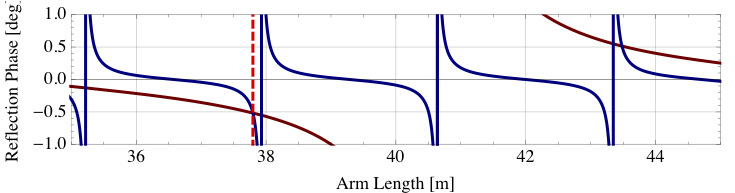
With the parameters of the 40m IFO, 37.7974m is the possible arm cavity length. (This number is ~10inch longer than the arm length of 37.54m as of Jan 2011).
The PRC length is adjusted to resonate the f1 and f2 sidebands in the PRC. (6.7538m) This macroscopic change compensates the additional phase gained by the arm reflection for f1 and f2. (Add 4m to the horizontal axis of the figure)

Similarly, the SRC length is adjusted to maximize the f2 transmission to the dark port. (5.39915m) (Add 4m to the horizontal axis of the figure)

Then the asymmetry is adjusted to maximize the f2 sideband transmission to the dark port. (0.0342m) (Add 4m to the vertical axis of the figure) As seen in the figure, the resonant condition is now independent to the asymmetry.

Finnese code for the above calculations can be found here: