
|
Size: 6450
Comment:
|
Size: 11889
Comment:
|
| Deletions are marked like this. | Additions are marked like this. |
| Line 1: | Line 1: |
| == A New RF System For the Upgrade == The Upgraded 40 Meter will have an entirely new configuration of the RF system. That is mostly because: |
## page was renamed from Upgrade 09/RF System ## page was renamed from Upgrade 09/PDs ## All the data from Upgrade 09/RF System/Upgraded RF Photodiodes were transported to this page '''Index of sections''' <<TableOfContents()>> |
| Line 4: | Line 6: |
| 1. the length of the short cavities will change (getting longer); 1. the interferometer will be set in a [[broadband sensing configuration]] and [[a new locking scheme]] and signals will be necessary. ---- === Requirements === 1. Need control of the modulation depths from the control room. This makes us either keep the current RFAM Stab. boxes or we put in our own remote control attenuators. |
[[Electronics/RF System/RF Checklist|RF Checklist]] ------ = the New RF System = == Overview == . The Upgraded 40 Meter will have an entirely new configuration of the RF system. That is mostly because: . 1. the length of the short cavities will change (getting longer); . 2. the interferometer will be set in a broadband sensing configuration and a new locking scheme and signals will be necessary. . This is how the new RF system will look like. . <<ImageLink(RFsystem_plant_VISIO.png, width=700)>> . A PDF version of the diagram can be found[attachment:RFsystem_plant_VISIO.pdf here]. . [https://nodus.ligo.caltech.edu:30889/UpgradeRFplan/yEd_RFplan_rev6.html Here's an older version of the plan made with yEd.] Descriptions of the single components in the diagram are shown just by passing over them with the mouse. Clicking on them links to the correspondent data sheet. The numbers included in the diagrams describe the limit case of the highest modulation depth that we may use at the 40m (gamma=0.3). == Requirements == 1. Need control of the modulation depths from the control room. Either we keep the current RFAM Stab. boxes or we introduce our own remote control attenuators. |
| Line 13: | Line 29: |
| ---- === Main Features of the new RF Scheme === The change of the length of the recycling cavities will impose different sideband frequencies. The frequency f1 of the first sideband will be now about 11 MHz, ad the second one will be 5xf1=55 MHz. ==== Sideband generation ==== The modulations will be generated by a single [[broadband EOM]], thus ending the current configuration with the two EOMs in parallel in the Mach-Zehnder. Also there will be a single main oscillator to generate the main 11 MHz frequency. All the other signals, with frequencies multiple of the main one, 2x, 3x, 5x, 10x, 15x respectively, will be generated starting from it, rather than by independent oscillators. f1 will be generated by a crystal oscillator; f2 will be obtained by f1 by means of a [[5-time frequency multiplier]]. The two signals will then be combined into one which will modulate the [[EOM driver]]. The designed modulation depth for the Upgrade will range somewhere in between 0.1 and 0.3. The New Focus KTP 4064 boradband EOM has an efficiency factor of 13mrad/V. That means that the driving voltage should range between 8 and 23 V, that is between 30 dBm and 40 dBm. The frequency multiplier will output 20 dBm, so 20 dBm will have to be gained by the signals before the EOM in order to match the requirements on the modulation depth. The step will be covered in part by the [[EOM driver]] in part by an low noise, high power amplifier placed in between. The requirements on this amplifier depend on the gain achieved by the EOM driver, which is still unknown for sure at the moment. Although we can expect two possible scenarios: a. (very) pessimistic: the driver won't be able to provide a positive gain a. realistic: the driver will give us about 10 dB a. optimistic: the driver will provide 20 dB as in theory In either case the choice of the amplifier will be different. For instance, the following could be two possible candidates: a. +20 dB gain by [http://www.ophirrf.com/files/products/5303055.pdf Ophir Solid State Broadband High Power RF Amplifier 5303055] a. +10 dB gain: this will be hard, because we will need something that makes the step from +20 dBm to +30 dBm which is not a lot in terms of gain (+10 dB) but the input and output power are rather high; unless we ask for less than +20 dBm at the output of the multiplier. If, for instance we had 8-10 dBm coming from the multiplier, then this [http://www.cougarcorp.com/databasePDF_Files/A2CP2596.pdf A2CP2596] by Teledyne Cougar Corp. could be a candidate. a. no amplifier will be needed (?) After the multiplier and before the driver, the f5 signal will be have to be amplified ==== RF photodiodes demodulation ==== The plan under study also uses the same signal from the main oscillator for the demodulation of the signals from the RF photodiodes. |
|
| Line 44: | Line 31: |
| === Plan drafts === I've laid down a few slightly different layouts for the Upgrade RF System. The numbers included in the diagrams describe the limit case of the highest modulation depth that we may use at the 40m (gamma=0.3). |
= Main Features of the new RF Scheme = == Change in Length and Frequency == . The change of the length of the recycling cavities will impose different sideband frequencies. . (It is actually the other way around, since we're changing the cavity lengths in order to accommodate lower modulation frequencies). . '''f1 = 11065399 Hz ''' and ''' f2 = 5xf1 =55326995 Hz '''. == Sideband generation == * The modulations will be generated by ''' a single broadband EOM ''', thus ''' no Mach-Zehnder any more '''. |
| Line 47: | Line 39: |
| (''You can read the description of the single components in the diagram just by passing over them with the mouse. Clicking on them links to the correspondent data sheet'') | * There will be ''' a single master oscillator ''' to generate the main 11 MHz frequency. * {i} All the other signals, with frequencies multiple of the main one, 2x, 3x, 5x, 10x, 15x respectively, will be generated starting from it, rather than by independent oscillators. |
| Line 49: | Line 43: |
| A. [https://nodus.ligo.caltech.edu:30889/UpgradeRFplan/yEd_RFplan_without_Coupler.html The first option] maintains the same RF AM Stabilizers used at the present to tune the modulation depth A. [https://nodus.ligo.caltech.edu:30889/UpgradeRFplan/yEd_RFplan_with_Coupler.html The second option] __totally abandons the old RF AM stabilizers__ ('''''I like this more''''') A. [https://nodus.ligo.caltech.edu:30889/UpgradeRFplan/yEd_RFplan_hybrid_Coupler.html A variation] of the second plan which still uses the AM stabilizer but only for the Mode Cleaner |
* f1 will be generated by ''' a crystal oscillator ''' * {i} f2 will be obtained by f1 by means of a 5-time frequency multiplier. The two signals will be ''' electrically combined''' before the EOM |
| Line 53: | Line 46: |
| ==== Rana's Suggested Changes ==== In addition to the requirements listed above, Rana suggested the following changes/additions to plan B: * replace the directional coupler with splitters * replace LIGO LSC Frequency Distribution splitters with 8-way power splitters from Mini-Circuit * include cable power losses in the calculations * abandon the 2 Omega I and Q Demodulator Board * buy a voltage controlled attenuator to test it * check what's the modulation depth we need for the mode cleaner and evaluate whether we need a high-power amplifier for the 29MHz as well as for the 11 and 55MHz * redesign the cabling: check out Intra-Flex for custom made cables * ask Rich to order 2 11MHz crystals and 2 29.5MHz crystals |
* The designed modulation depth for the Upgrade will range somewhere in between 0.1 and 0.3. * {i} The New Focus KTP 4064 boradband EOM has an efficiency factor of 13mrad/V. Therefore the driving voltage should range between 30 dBm and 40 dBm. However the frequency multiplier will output 20 dBm, so 20 dBm will have to be gained by the signals before the EOM in order to match the requirements on the modulation depth. * {i} The step will be covered in part by the [[Electronics/Multi_Resonant_EOM|Multiple-resonant EOM]] in part by an low noise, high power amplifier placed in between. * {i} After the multiplier and before the driver, the f5 signal will be have to be amplified |
| Line 64: | Line 51: |
| [https://nodus.ligo.caltech.edu:30889/UpgradeRFplan/yEd_RFplan_with_Coupler_rev2.html Here's a diagram which includes the main changes suggested by Rana]. The calculations of the power along the chain still does not include the cable losses. That is what is going to follow very soon. | == Demodulation == === Concepts of the Upgrade === * Use of the same signal from the main oscillator for the demodulation * The same demod boards as the old 40m: [attachment:LIGOD990511.pdf LIGO D990511]. * Installation of surface mount low-pass filters in correspondence of U5 (as in the schematic): * Installation of high pass filters to the RFPD input of the demod boards (e.g. SHP-25 for 55 MHz demod board) |
| Line 66: | Line 58: |
| ==== SNR Calculations ==== | === Installation status === . Find the actual setups here : [[Electronics/LSC_demoddulators|LSC dmoedulators]] |
| Line 68: | Line 61: |
| Here are the diagrams showing the [https://nodus.ligo.caltech.edu:30889/UpgradeRFplan/yEd_RFplan_with_Coupler_rev2_phase Noise.html Noise Power] and the [https://nodus.ligo.caltech.edu:30889/UpgradeRFplan/yEd_RFplan_with_Coupler_rev2_SNR.html SNR] in the RF System, respectively. | |
| Line 70: | Line 62: |
| ==== Tables and diagrams ==== [attachment:40mUpgrade_PDlists.pdf Table of old and new PDs plus diagram of signal extraction scheme] |
== Frequency Generation and Distribution == === Installation status === . This page describes the [[Electronics/RF System/frequency generation box|frequency generation box]]. . This page describes the [[Electronics/RF System/frequency distribution box|frequency distribution box]]. |
| Line 73: | Line 67: |
| [attachment:40mPDs.pdf Table of PDs and Demodulators] | === Hartmut's Suggestions === * Grounding inside the [[Electronics/RF System/frequency generation box|frequency generation box]]. If we choose to mount the single components inside the box on to a conducting surface, they should make good contact with it. Bad contact can come from oxide forming on the surface, or by mere unevenness of the surface. for this reason at GEO, to make sure they wouldn't incur into this issue, they mounted the components on a plastic [http://www.williams-sonoma.com/products/7256886/popup/view-larger.html?zoom=1 breadboard]. * Testing the system. Bad connectors, bad cables, bad soldering can all deteriorate the modulation/demodulation signals and eventually produce phase noise that goes into the demod mixers. One way to measure the presence of phase noise is to pick off with a coupler a demod signals from just before the modualtions' combiner and use it as a local oscillator in the demod boxes. Then we can connect audio earphones to the demodualted output and listen for phase noise. That would simulate the 'closed loop' made by the IFO and the actual phase nosie present in the modulation/demodulation chain. We could test single connections or cables, inside the frequency generation box or in the frequency distribution board by touching/shaking them and listening to the earphones. ---- = Modulation/demodulation system's SNR calculation = . See Alberto's thesis [https://nodus.ligo.caltech.edu:30889/svn/trunk/alberto/thesis/main/main.pdf 40m svn] ----- = RF Photodetectors = [http://blue.ligo-wa.caltech.edu:8000/40m/Upgrade_09/RF_System/Upgraded_RF_Photodiodes This page follows the state of the work in progress on the RF photodiodes upgrade] == Baseline RFPDs and LSC Signals == . For locking, the baseline plan is to use the same error signals of AdvLIGO: || '''DOF''' || '''Signal''' || || CARM || REFL_I1 || || DARM || AS_DC || || PRCL || POP_I1 || || MICH || POP_Q2 || || SRCL || POP_I2 || . In case that '''3f signals''' will be used for lock acquisition, as a result of Optickle simulations, we propose the following sensing matrix: || '''DOF''' || '''Signal''' || || X || POX || || Y || POY || || PRCL || REFL_32I || || MICH || REFL_31I || || SRCL || REFL_32Q || == Photodiode properties == . [http://www.ligo.caltech.edu/docs/D/D000455-00.pdf The LIGO document D000455-00-C is the one that resembles the most the board inside the "golden boxes" resembles]. . [attachment:C3064XGH.pdf Here's the datasheet of the photodiode.] . [attachment:cat_photodetection.pdf More specs for the diodes (as diode shunt resistance) can be found inthis]. . [attachment:AbbottC30642.pdf This document by Rich Abbott contains lots of measurements of PD capacitance and resistance.] . We're going to adapt the current photodetectors for the new signals as described in the following table: || '''Photodetector''' || '''Adapted From''' || '''Changes''' || '''Parts Needed''' || '''Modeling''' || '''Measurements''' || || '''REFL11''' || [attachment:refl11_modified_schematic.pdf REFL33 (PD2)] || C34 || tunable capacitor: SD3012-ND 9-120 pF || [attachment:rfpd11.fil LISO file], [attachment:rfpd11_TF_and_noise.pdf LISO plots] || || || || || L4 || tunable inductor: !CoilCraft 143-10J12L || || || || || || L5 || tunable inductor: !CoilCraft 143-20J12L || || || || '''POX11''' || [attachment:POX11_modified_schematic.pdf POX33 (PD3)] || C34 || tunable capacitor: SD3012-ND 9-120 pF || [attachment:rfpd11.fil LISO file], [attachment:rfpd11_TF_and_noise.pdf LISO plots] || || || || || L4 || tunable inductor: !CoilCraft 143-10J12L || || || || || || L5 || tunable inductor: !CoilCraft 143-20J12L || || || || '''POY11''' || [attachment:POY11_modified_schematic.pdf POY33 (PD4)] || C34 || tunable capacitor: SD3012-ND 9-120 pF || [attachment:rfpd11.fil LISO file], [attachment:rfpd11_TF_and_noise.pdf LISO plots] || || || || || L4 || tunable inductor: !CoilCraft 143-10J12L || || || || || || L5 || tunable inductor: !CoilCraft 143-20J12L || || || || '''REFL55''' || [attachment:REFL55_modified_schematic.pdf REFL199 (PD6)] || diode || 2mm !InGaAs diode (C30642GH) || [attachment:rfpd55.fil LISO file], [attachment:rfpd55_TF_and_noise.pdf LISO plots] || || || || || C34 || tunable capacitor: SD3012-ND 9-120 pF || || || || || || L4 || tunable inductor: !CoilCraft 164-02A06SL || || || || || || L5 || tunable inductor: !CoilCraft 164-04A06SL || || || || '''AS55''' || [attachment:AS55_modified_schematic.pdf AS133 (PD9)] || diode || 2mm !InGaAs diode (C30642GH) || [attachment:rfpd55.fil LISO files], [attachment:rfpd55_TF_and_noise.pdf LISO plots] || || || || || C34 || tunable capacitor: SD3012-ND 9-120 pF || || || || || || L4 || tunable inductor: !CoilCraft 164-02A06SL || || || || || || L5 || tunable inductor: !CoilCraft 164-04A06SL || || || || REFL33 || SPOB66 || TBD || TBD || TBD || || || REFL166 || REFL166 (PD11) || TBD || TBD || TBD || || || AS166 || AS166 (PD1) || TBD || TBD || TBD || || || POP22 || PO133 (PD7-8) || TBD || TBD || TBD || || || POP110 || PO199 (PD7-8) || TBD || TBD || TBD || || || MCREFL || MCREFL || TBD || TBD || TBD || || ----- = Upgrade Schedule = . As of Sunday July 25th, the remainder of the RF System Upgrade is organized in blocks as below. . The daily schedule can be found in this [http://www.google.com/calendar/embed?src=0606mdhpbl7m9m4ctue2po80ls@group.calendar.google.com&ctz=America/Los_Angeles RF System Upgrade Google Calendar] * '''(2 weeks: Sun Jul 25 -> Fri Aug 6): [[Electronics/RF System/schedule/RF Generation|RF Generation]] ''' * '''(2 weeks: Mon Aug 9 -> Fri Aug 20): [[Electronics/RF System/schedule/RF Distribution|RF Distribution]]''' * '''(3.5 weeks: Sun Aug 22 -> Wed Sep 8th): [[Electronics/RF System/schedule/LSC PDs|LSC PDs]]''' * '''(2 weeks: Thu Sept 16 -> Fri Oct 1st): [[/schedule/Commissioning]]''' . {i} [[Electronics/RF System/RF Checklist|RF Checklist]] ----- = Plan reviews = . In addition to the requirements listed above, Rana suggested the following changes/additions to plan B: . (./) replace the directional coupler with splitters . (./) replace LIGO LSC Frequency Distribution splitters with 8-way power splitters from Mini-Circuit . (./) include cable power losses in the calculations . (./) abandon the 2 Omega I and Q Demodulator Board . (./) buy a voltage controlled attenuator to test it * check what's the modulation depth we need for the mode cleaner and evaluate whether we need a high-power amplifier for the 29MHz as well as for the 11 and 55MHz . (./) redesign the cabling: check out Intra-Flex for custom made cables . (./) a band-pass filter before each demodulator board ----- = References, Some diagrams and Links = == Tables and Diagrams == . [attachment:40mUpgrade_PDlists.pdf Table of old and new PDs plus diagram of signal extraction scheme] . [attachment:40mPDs.pdf Table of PDs and Demodulators] == References == . Documentation of the design, construction and characterization of the RF System is now available in the [attachment:RFsystemDocument LIGO DOC# T000461]. . Coax cables [[Electronics/Coaxial_Cables|Coaxial Cables]] == Purchase List == . [[Upgrade 09/Purchase List/RF electronics|A list of the components that we have to buy can be found here]]. |
Index of sections
Contents
the New RF System
Overview
- The Upgraded 40 Meter will have an entirely new configuration of the RF system. That is mostly because:
- 1. the length of the short cavities will change (getting longer);
- 2. the interferometer will be set in a broadband sensing configuration and a new locking scheme and signals will be necessary.
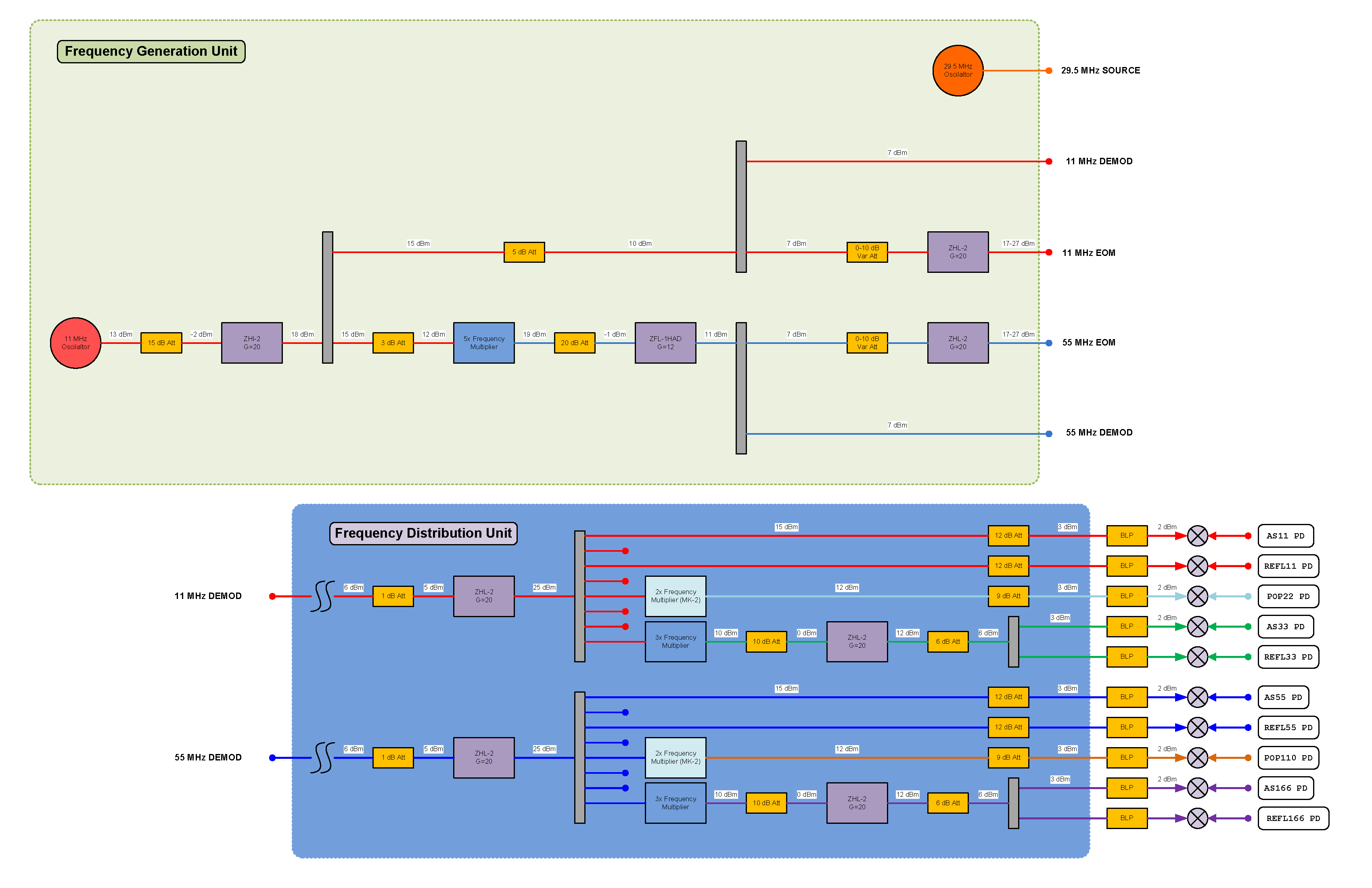
- This is how the new RF system will look like.
- A PDF version of the diagram can be found[attachment:RFsystem_plant_VISIO.pdf here].
[https://nodus.ligo.caltech.edu:30889/UpgradeRFplan/yEd_RFplan_rev6.html Here's an older version of the plan made with yEd.] Descriptions of the single components in the diagram are shown just by passing over them with the mouse. Clicking on them links to the correspondent data sheet. The numbers included in the diagrams describe the limit case of the highest modulation depth that we may use at the 40m (gamma=0.3).
Requirements
- Need control of the modulation depths from the control room. Either we keep the current RFAM Stab. boxes or we introduce our own remote control attenuators.
- The system needs to preserve the low phase noise of the Wenzel crystal and multiplier (~ -160dBc/Hz).
- Care should be taken to avoid reflections. There should be an amplifier at each split to avoid reflections between the loads from cross-talking.
- Wherever we have high level signals, we need to use the Heliax cable. Each Heliax cable must be strain releieved at each end. The connection between the Heliax and the components shall be the same semi-rigid RG-174 as we have now or some equally low radiation type.
- All connections shall be SMA or type N. Absolutely no BNC allowed.
Main Features of the new RF Scheme
Change in Length and Frequency
- The change of the length of the recycling cavities will impose different sideband frequencies.
- (It is actually the other way around, since we're changing the cavity lengths in order to accommodate lower modulation frequencies).
f1 = 11065399 Hz and f2 = 5xf1 =55326995 Hz .
Sideband generation
The modulations will be generated by a single broadband EOM , thus no Mach-Zehnder any more .
There will be a single master oscillator to generate the main 11 MHz frequency.
 All the other signals, with frequencies multiple of the main one, 2x, 3x, 5x, 10x, 15x respectively, will be generated starting from it, rather than by independent oscillators.
f1 will be generated by a crystal oscillator
- f2 will be obtained by f1 by means of a 5-time frequency multiplier. The two signals will be electrically combined before the EOM
- The designed modulation depth for the Upgrade will range somewhere in between 0.1 and 0.3.
- The New Focus KTP 4064 boradband EOM has an efficiency factor of 13mrad/V. Therefore the driving voltage should range between 30 dBm and 40 dBm. However the frequency multiplier will output 20 dBm, so 20 dBm will have to be gained by the signals before the EOM in order to match the requirements on the modulation depth.
- The step will be covered in part by the Multiple-resonant EOM in part by an low noise, high power amplifier placed in between.
- After the multiplier and before the driver, the f5 signal will be have to be amplified
Demodulation
Concepts of the Upgrade
- Use of the same signal from the main oscillator for the demodulation
- The same demod boards as the old 40m: [attachment:LIGOD990511.pdf LIGO D990511].
- Installation of surface mount low-pass filters in correspondence of U5 (as in the schematic):
- Installation of high pass filters to the RFPD input of the demod boards (e.g. SHP-25 for 55 MHz demod board)
Installation status
Find the actual setups here : LSC dmoedulators
Frequency Generation and Distribution
Installation status
This page describes the frequency generation box.
This page describes the frequency distribution box.
Hartmut's Suggestions
Grounding inside the frequency generation box. If we choose to mount the single components inside the box on to a conducting surface, they should make good contact with it. Bad contact can come from oxide forming on the surface, or by mere unevenness of the surface. for this reason at GEO, to make sure they wouldn't incur into this issue, they mounted the components on a plastic [http://www.williams-sonoma.com/products/7256886/popup/view-larger.html?zoom=1 breadboard].
- Testing the system. Bad connectors, bad cables, bad soldering can all deteriorate the modulation/demodulation signals and eventually produce phase noise that goes into the demod mixers. One way to measure the presence of phase noise is to pick off with a coupler a demod signals from just before the modualtions' combiner and use it as a local oscillator in the demod boxes. Then we can connect audio earphones to the demodualted output and listen for phase noise. That would simulate the 'closed loop' made by the IFO and the actual phase nosie present in the modulation/demodulation chain. We could test single connections or cables, inside the frequency generation box or in the frequency distribution board by touching/shaking them and listening to the earphones.
Modulation/demodulation system's SNR calculation
See Alberto's thesis [https://nodus.ligo.caltech.edu:30889/svn/trunk/alberto/thesis/main/main.pdf 40m svn]
RF Photodetectors
[http://blue.ligo-wa.caltech.edu:8000/40m/Upgrade_09/RF_System/Upgraded_RF_Photodiodes This page follows the state of the work in progress on the RF photodiodes upgrade]
Baseline RFPDs and LSC Signals
- For locking, the baseline plan is to use the same error signals of AdvLIGO:
DOF
Signal
CARM
REFL_I1
DARM
AS_DC
PRCL
POP_I1
MICH
POP_Q2
SRCL
POP_I2
In case that 3f signals will be used for lock acquisition, as a result of Optickle simulations, we propose the following sensing matrix:
DOF
Signal
X
POX
Y
POY
PRCL
REFL_32I
MICH
REFL_31I
SRCL
REFL_32Q
Photodiode properties
[http://www.ligo.caltech.edu/docs/D/D000455-00.pdf The LIGO document D000455-00-C is the one that resembles the most the board inside the "golden boxes" resembles].
- [attachment:C3064XGH.pdf Here's the datasheet of the photodiode.]
- [attachment:cat_photodetection.pdf More specs for the diodes (as diode shunt resistance) can be found inthis].
[attachment:AbbottC30642.pdf This document by Rich Abbott contains lots of measurements of PD capacitance and resistance.]
- We're going to adapt the current photodetectors for the new signals as described in the following table:
Photodetector
Adapted From
Changes
Parts Needed
Modeling
Measurements
REFL11
[attachment:refl11_modified_schematic.pdf REFL33 (PD2)]
C34
tunable capacitor: SD3012-ND 9-120 pF
[attachment:rfpd11.fil LISO file], [attachment:rfpd11_TF_and_noise.pdf LISO plots]
L4
tunable inductor: CoilCraft 143-10J12L
L5
tunable inductor: CoilCraft 143-20J12L
POX11
[attachment:POX11_modified_schematic.pdf POX33 (PD3)]
C34
tunable capacitor: SD3012-ND 9-120 pF
[attachment:rfpd11.fil LISO file], [attachment:rfpd11_TF_and_noise.pdf LISO plots]
L4
tunable inductor: CoilCraft 143-10J12L
L5
tunable inductor: CoilCraft 143-20J12L
POY11
[attachment:POY11_modified_schematic.pdf POY33 (PD4)]
C34
tunable capacitor: SD3012-ND 9-120 pF
[attachment:rfpd11.fil LISO file], [attachment:rfpd11_TF_and_noise.pdf LISO plots]
L4
tunable inductor: CoilCraft 143-10J12L
L5
tunable inductor: CoilCraft 143-20J12L
REFL55
[attachment:REFL55_modified_schematic.pdf REFL199 (PD6)]
diode
2mm InGaAs diode (C30642GH)
[attachment:rfpd55.fil LISO file], [attachment:rfpd55_TF_and_noise.pdf LISO plots]
C34
tunable capacitor: SD3012-ND 9-120 pF
L4
tunable inductor: CoilCraft 164-02A06SL
L5
tunable inductor: CoilCraft 164-04A06SL
AS55
[attachment:AS55_modified_schematic.pdf AS133 (PD9)]
diode
2mm InGaAs diode (C30642GH)
[attachment:rfpd55.fil LISO files], [attachment:rfpd55_TF_and_noise.pdf LISO plots]
C34
tunable capacitor: SD3012-ND 9-120 pF
L4
tunable inductor: CoilCraft 164-02A06SL
L5
tunable inductor: CoilCraft 164-04A06SL
REFL33
SPOB66
TBD
TBD
TBD
REFL166
REFL166 (PD11)
TBD
TBD
TBD
AS166
AS166 (PD1)
TBD
TBD
TBD
POP22
PO133 (PD7-8)
TBD
TBD
TBD
POP110
PO199 (PD7-8)
TBD
TBD
TBD
MCREFL
MCREFL
TBD
TBD
TBD
Upgrade Schedule
- As of Sunday July 25th, the remainder of the RF System Upgrade is organized in blocks as below.
The daily schedule can be found in this [http://www.google.com/calendar/embed?src=0606mdhpbl7m9m4ctue2po80ls@group.calendar.google.com&ctz=America/Los_Angeles RF System Upgrade Google Calendar]
(2 weeks: Sun Jul 25 -> Fri Aug 6): RF Generation
(2 weeks: Mon Aug 9 -> Fri Aug 20): RF Distribution
(3.5 weeks: Sun Aug 22 -> Wed Sep 8th): LSC PDs
(2 weeks: Thu Sept 16 -> Fri Oct 1st): /schedule/Commissioning
Plan reviews
- In addition to the requirements listed above, Rana suggested the following changes/additions to plan B:
 replace the directional coupler with splitters
 - replace LIGO LSC Frequency Distribution splitters with 8-way power splitters from Mini-Circuit
- include cable power losses in the calculations
- abandon the 2 Omega I and Q Demodulator Board
- buy a voltage controlled attenuator to test it
- check what's the modulation depth we need for the mode cleaner and evaluate whether we need a high-power amplifier for the 29MHz as well as for the 11 and 55MHz
- redesign the cabling: check out Intra-Flex for custom made cables
- a band-pass filter before each demodulator board
References, Some diagrams and Links
Tables and Diagrams
- [attachment:40mUpgrade_PDlists.pdf Table of old and new PDs plus diagram of signal extraction scheme]
- [attachment:40mPDs.pdf Table of PDs and Demodulators]
References
- Documentation of the design, construction and characterization of the RF System is now available in the [attachment:RFsystemDocument LIGO DOC# T000461].
Coax cables Coaxial Cables