
|
Size: 7180
Comment:
|
Size: 7209
Comment:
|
| Deletions are marked like this. | Additions are marked like this. |
| Line 24: | Line 24: |
| * Configuration Utilities | * [[Configuration Utilities||attachment:9500465D.zip]] |
Slow Controls
Old Slow Controls Machines (Pre-2017)
Contents
Auxiliary DAQ Modules
The auxiliary DAQ system uses the Acromag XT series DIN-rail mounted ADC, DAC and BIO modules. The model numbers are in the format XTYYY1, where "XT" is a static prefix, "YYY" determines the function, and the "1" as the last digit denotes the ModBus/TCP version of the model. The 1 at the end is important, as the other variations will not be able to interface with CDS through EPICS.
Module |
Function |
# Channels |
Notes |
Manual |
XT1111 |
BIO |
16 |
Sinking outputs |
|
XT1121 |
BIO |
16 |
Sourcing outputs |
|
XT1221 |
ADC |
8 |
Differential inputs |
|
XT1541 |
DAC |
8 |
4 sourcing output BIO channels |
HowTo
Configure Acromag XT modules
Initial configuration via USB is required before the units can be used on the network. This requires:
- USB-to-miniUSB cable
- Microsoft Windows (virtual) machine
Each model requires a different flavor of the utility to be run. The to-be-configured device needs to be powered by a 12-32V DC voltage source.
Network Configuration
The primary screen looks identical for all models:
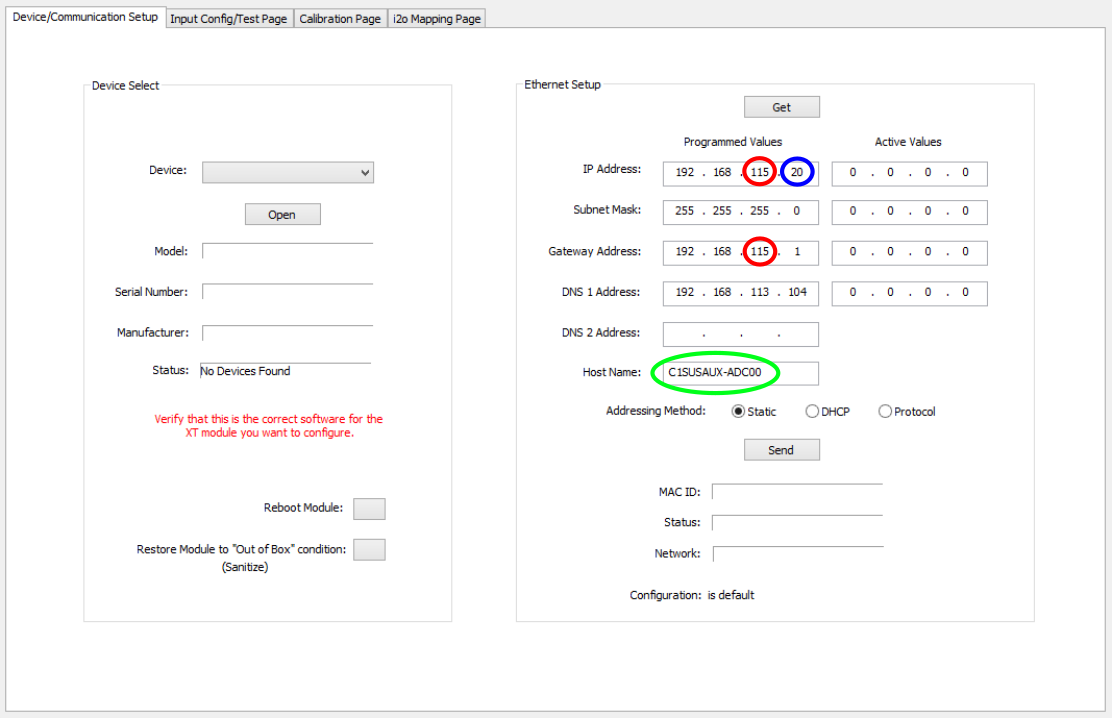
Hostname |
Local IP |
C1X-ADCYY |
192.168.11X.2Y |
C1X-DACYY |
192.168.11X.4Y |
C1X-BIOYY |
192.168.11X.6Y |
Configure slow controls server machine
The following has proven to work with Debian Jessie running on a Supermicro SYS-5015A-H (Intel Atom processor without 64-bit support). This guide was written after-the-fact, so some steps may be missing. When configuring the next machine the gaps will be filled.
- Fresh install of Debian Jessie
username: controls
optional: lightweight desktop environment LXDE
Give sudo privileges to controls
- su
- usermod -aG sudo controls
- Set up SSH access
- sudo apt-get install openssh-client
- Set up martian and local ethernet adapters
- Edit /etc/network/interfaces
allow-hotplug eth0 iface eth0 inet static
- address 192.168.113.XX netmask 255.255.255.0 gateway 192.168.113.2 dns-nameservers 192.168.113.104 131.215.125.1 131.215.139.100 dns-search martian
allow-hotplug eth1 iface eth1 inet static
- address 192.168.11Y.1 netmask 255.255.255.0 network 192.168.11Y.0 broadcast 192.168.11Y.255
Hostname |
Martian IP |
Local IP |
C1SUSAUX |
192.168.113.??? |
192.168.115.1 |
C1AUXEX |
192.168.113.??? |
192.168.114.1 |
C1AUXEY |
192.168.113.??? |
192.168.11?.1 |
C1PSL |
192.168.113.??? |
192.168.11?.1 |
C1VAC |
192.168.113.??? |
192.168.11?.1 |
C1??? |
192.168.113.??? |
192.168.11?.1 |
- Set up remote file system access
- sudo apt-get install nfs-common
- Set up systemd service for automatic start of the Modbus IOC
- sudo apt-get install procserv
Configure XT unit Modbus driver
# Use the following commands for TCP/IP
# drvAsynIPPortConfigure(const char *portName,  # user-defined: used for subsequent referencing,
#                        const char *hostInfo,  # format: "IP-Address:Port". Standard port for Modbus is 502
#                        unsigned int priority, #
#                        int noAutoConnect,     #
#                        int noProcessEos);     #
#
# Examples:
# drvAsynIPPortConfigure("<TCP_PORT_NAME>","<UNIT_IP_ADDRESS>:502",0,0,1)
# drvAsynIPPortConfigure("c1auxex_xt1221a","192.168.114.11:502",0,0,1)
# modbusInterposeConfig(const char *portName, # reference to portName created with drvAsynIPPortConfigure command
# modbusLinkType linkType, #
# int timeoutMsec, # define timeout for waiting for response from unit
# int writeDelayMsec) #
#
# Example:
# modbusInterposeConfig("<TCP_PORT_NAME>",0,5000,0)
# modbusInterposeConfig("c1auxex_xt1221a",0,5000,0)#drvModbusAsynConfigure(portName, # used by channel definitions in .db file to reference this unit)
# tcpPortName, # reference to portName created with drvAsynIPPortConfigure command
# slaveAddress, #
# modbusFunction, # defines driver function for the unit (read register = 4, write register = 6, write single coil = 5) - see examples in next section
# modbusStartAddress, # ADC and binary channel numbering starts with 0, DAC channel numbering with 1
# modbusLength, # length in dataType units - see examples in next section
# dataType, # 4 = 16-bit signed integers (for A/D and D/A), 0 = binary (for BIO, duh)
# pollMsec, # how frequently to request a value in [ms]
# plcType); #
#
# Example:
# drvModbusAsynConfigure("<PORT_NAME>","<TCP_PORT_NAME>",0,<modbusFunction>,<modbusStartAddress>,<modbusLength>,<dataType>,<pollMsec>,"Acromag")
XT1221
drvModbusAsynConfigure("C1AUXEX_XT1221A_ADC","c1auxex_xt1221a",0,4,0,8,4,32,"Acromag")
XT1541
drvModbusAsynConfigure("C1AUXEX_XT1541A_DAC","c1auxex_xt1541a",0,6,1,8,4,32,"Acromag")
drvModbusAsynConfigure("C1AUXEX_XT1541A_BIO","c1auxex_xt1541a",0,5,0,4,0,32,"Acromag")
XT1111 & 1121
drvModbusAsynConfigure("C1AUXEX_XT1111A_BIO","c1auxex_xt1111a",0,6,0,4,0,32,"Acromag")
Define EPICS channels
Note: Modbus/TCP is simply a protocol for sending commands via TCP that the XT units can interpret, as in read/write the correct register values to/from the channels. There may be multiple ways to define the channels have the same effect. The settings reported here have been found to work as intended.
Many of the fields in the EPICS records are somewhat supplemental and not required for the channel definitions, but some have real effect in MEDM screens, such as upper limits on slider bars and the such.
XT1221
field(INP,"@asynMask(<ADC_UNIT_PORT_NAME> 0 -16)MODBUS_DATA")
XT1541
record(ao, "<AO_CHANNEL_NAME>")
{
        field(DTYP,"asynInt32")
        field(OUT,"@asynMask(<DAC_UNIT_PORT_NAME>, 0, -16)MODBUS_DATA")
}
record(bo, "<BO_CHANNEL_NAME>")
{
field(DTYP,"asynUInt32Digital")
field(OUT,"@asynMask(<DAC_UNIT_PORT_NAME>, 3, 0x1)")
}
XT1111 & 1121
record( bo, "CHANNEL_NAME")
{
        field(DTYP,"asynUInt32Digital")
        field(OUT,"@asynMask(BIO0_Reg, 0, 0x1)")
}