Overview
To lock the detuned RSE configuration (sort of like LIGO-I + signal recycling), all of the interferometer's length degrees of freedom (DOF) are brought under control from an uncontrolled state. Typically this results in resonating the laser field within the resonant cavities formed by the interferomter optics and gives us a configuration which is optimal for audio-frequency gravitational-wave sensitivity.
The basic idea behind the process here (which differs from the approach of initial LIGO) is to first bring the interferometer under control (to 'lock' it) using signals which are naturally reasonably well diagonalized, and which have a large useful range. This initial lock point need not be at the operating point. The intial signals are:
TRX -> ETMX
TRY -> ETMY
REFL33_I -> PRC
REFL33_Q -> MICH
REFL166_I -> SRC
These signals bring us to a point where there is effectively a large CARM offset, which means that both ARM cavities are detuned from resonance by the same amount, in the same direction. This point is the acquistion point.
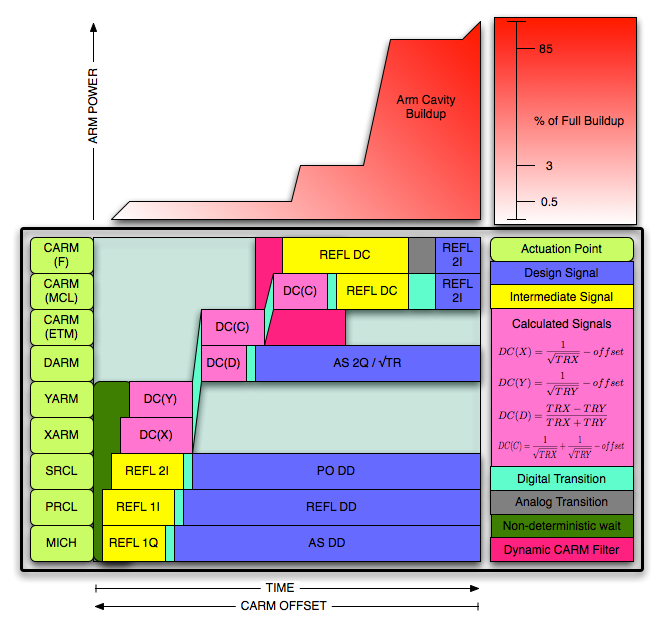
The remainder of the process of lock acquistion involves migration of signals and offsets, until the design configuration (the operating point) is achieved. For a detuned RSE ifo, this operating point might be something like:
DARM-> DC Readout
CARM -> REFL{1,2} I
PRCL -> REFL double demod
MICH -> AS double demod
SRCL -> PO double demod
The migrattory process which brings us from the acquistion point to the operating point is shown in the figure below. Some general notes on the procedure are in: proc.pdf
Detuned RSE lock acquisition procedure