
|
Size: 4346
Comment:
|
Size: 4485
Comment:
|
| Deletions are marked like this. | Additions are marked like this. |
| Line 1: | Line 1: |
| = The Intrepid Adventures in the 40m Upgrade Land of Optical Design = | = Got totally obsolete and isolated from other pages (May 9, 2011 KA) = |
| Line 3: | Line 3: |
| attachment:swamp.jpg | = The Intrepid Adventures in Optical Design Land = <<ImageLink(swamp.jpg, width=300)>> |
| Line 7: | Line 10: |
| * In [http://131.215.115.52:8080/40m/3001 elog entry 3001] we noted that the f2 sidebands were near resonance in the arms for the optical design with 38m arm. We then decided to extend the arm to 38.4m. | * In [http://131.215.115.52:8080/40m/3001 elog entry 3001] we noted that '''the f2 sidebands were near resonance in the arms''' for the optical design with 38m arm. We then decided to extend the arm to 38.4m. |
| Line 10: | Line 13: |
| ---- * The f2 SBs were still picking up about 0.7 degrees of phase upon reflection from the ITMs (see elog entry xxx). Such a phase shift spoils the resonance conditions in the central part of the interferometer. |
|
| Line 13: | Line 14: |
| Then, as noted in elog entry xxx, we changed the length of the PRC and SRC to restore the resoance conditions. | ------ * '''The f2 SBs were still picking up about 0.7 degrees of phase upon reflection from the ITMs''' (see elog entry xxx). Such a phase shift spoiled the resonance conditions in the central part of the interferometer. Then, as noted in elog entry [http://131.215.115.52:8080/40m/3227 3277], we changed the length of the PRC and SRC to restore the resoance conditions. |
| Line 16: | Line 21: |
| ---- * However, at that point, the conditions for the critical coupling of the f2 SBs in the central part were not guaranteed anymore (the signal recycling cavity, as seen from the BS side, should have the same reclectivity of the PRM, in order to maximize the f2 power transmitted to the dark port). |
|
| Line 19: | Line 22: |
| We realized that in order to guarantee the RSE conditions in the central part (f1 resoanant in PRC, f2 resonant in PRC and SRC, SRC critically coupled to PRM for f2), PRCL and SRCL macroscopic lengths, and Schnupp asymmetry had to be tuned simultaneusly. But since we don't know the shape of the rather complicated response of the sidebands to the central cavity, we couldn't really tune the parameters all at the same time. | ------ |
| Line 21: | Line 24: |
| Starting from the the previous solution, we then followed an iterative process to explore whta is a 3-dimensional space: 1) PRC length tuning to make f1 resonate in PRC 2) SRC length and lASY simultaneous tuning to maximise the power of f2 in SRC |
* However, at that point, the conditions for the critical coupling of the f2 SBs in the central part were not guaranteed anymore (the signal recycling cavity, as seen from the BS side, should have the same reflectivity of the PRM, in order to maximize the f2 power transmitted to the dark port). |
| Line 25: | Line 26: |
| <<ImageLink(minusf2CouplingConditions.png, width=750)>> | We realized that, in order to guarantee the RSE conditions in the central part (f1 resonant in PRC, f2 resonant in PRC and SRC, SRC critically coupled to PRM for f2), PRCL and SRCL macroscopic lengths, and Schnupp asymmetry had to be tuned simultaneously. But since we don't know the shape of the rather complicated response of the sidebands to the central cavity, we couldn't really tune all the parameters at the same time. Starting from the the previous solution, we then followed an iterative process to explore what is a 3-dimensional space: 1. PRC length tuning to make f1 resonate in PRC 2. SRC length and lASY simultaneous tuning to maximise the power of f2 in SRC <<ImageLink(minusf2CouplingConditions.png, width=500)>> |
| Line 28: | Line 35: |
| ---- * After, when we looked at the RF power at the ports, we noticed that f2 was much stronger in POX than in POY (or maybe vice-versa, not sure anymore about that). It was evident that since we moved from the ideal configuration of the interferometer, the X and the Y arms started seeing two different cavities (think of the cavity made of the either ITM and the rest of the ifo). Although, we have to say, the upper and the lower sidebands were still equal for both f1 and f2, which means that detuning was not happening. |
------ * After, when we looked at the RF power at the ports, we noticed that '''f2 was much stronger in POX than in POY''' (or maybe vice-versa, not sure anymore about that). It was evident that since we moved from the ideal configuration of the interferometer, the X and the Y arms started seeing two different cavities (think of the cavity made of the either ITM and the rest of the ifo). Although the upper and the lower sidebands were still equal for both f1 and f2, which means that detuning was not occurring. |
| Line 36: | Line 45: |
| We found a solution at: '''larm = 38.4; lSRC = 5.4006; lPRC = 6.74668; lASY = 0.0568;''' | We found a solution at: '''larm = 38.4; lSRC = 5.4225; lPRC = 6.74668; lASY = 0.0568;''' |
| Line 38: | Line 47: |
| <<ImageLink(centralParametersOptimization_ASY.png, width=600)>> <<ImageLink(centralParametersOptimization_PRC.png, width=600)>> <<ImageLink(centralParametersOptimization_SRC.png, width=600)>> ---- * Recently we also looked at the 3f demodulation signals and we noticed that the 3f2 signals at the REFL port were somehow affected by the CARM offset - which would defeat the purpose of having the 3f. In particular, the lock points for PRCL and MICH move for a few nm when the cavity power builds up to 100%. |
<<ImageLink(centralParametersOptimization_PRC.png, width=750)>> <<ImageLink(centralParametersOptimization_SRC.png, width=750)>> <<ImageLink(centralParametersOptimization_ASY.png, width=800)>> |
| Line 44: | Line 51: |
| <<ImageLink(errorSignals3f_nonideallength_all.png, width=750)>> <<ImageLink(errorSignals3f_nonideallength_all_optgain_lockpoint.png, width=750)>> | ------ |
| Line 46: | Line 53: |
| Just for an example, compare it with an improbable ideal optical design in which the ars are 47m long. | * Recently '''we also looked at the 3f demodulation signals''' and we noticed that the 3f2 signals at the REFL port were somehow affected by the CARM offset - which would defeat the purpose of having the 3f. In particular, the lock points for PRCL and MICH move for a few nm when the cavity power builds up to 100%. |
| Line 48: | Line 55: |
| <<ImageLink(errorSignals3f_ideallength_all.png, width=750)>> <<ImageLink(errorSignals3f_ideallength_all_optgain_lockpoint.png, width=750)>> | <<ImageLink(errorSignals3f_nonideallength_all.png, width=1200)>> <<ImageLink(errorSignals3f_nonideallength_all_optgain_lockpoint.png, width=550)>> Just for an example, compare it with an improbable ideal optical design in which the arms are 47m long. <<ImageLink(errorSignals3f_ideallength_all.png, width=1200)>> <<ImageLink(errorSignals3f_ideallength_all_optgain_lockpoint.png, width=550)>> |
Got totally obsolete and isolated from other pages (May 9, 2011 KA)
The Intrepid Adventures in Optical Design Land

Here's a summary of the optical design process that has been going on on for the past few months.
In [http://131.215.115.52:8080/40m/3001 elog entry 3001] we noted that the f2 sidebands were near resonance in the arms for the optical design with 38m arm. We then decided to extend the arm to 38.4m.
The cavity parameters became (in m): larm = 38.4; lSRC = c/f2 = 5.4185; lPRC = (0+0.5)*c/2/f1 = 6.7731; lASY = 0.0308;
The f2 SBs were still picking up about 0.7 degrees of phase upon reflection from the ITMs (see elog entry xxx). Such a phase shift spoiled the resonance conditions in the central part of the interferometer.
Then, as noted in elog entry [http://131.215.115.52:8080/40m/3227 3277], we changed the length of the PRC and SRC to restore the resoance conditions.
larm = 38.4; lSRC = 5.3573; lPRC = 6.74659; lASY = 0.0308;
- However, at that point, the conditions for the critical coupling of the f2 SBs in the central part were not guaranteed anymore (the signal recycling cavity, as seen from the BS side, should have the same reflectivity of the PRM, in order to maximize the f2 power transmitted to the dark port).
We realized that, in order to guarantee the RSE conditions in the central part (f1 resonant in PRC, f2 resonant in PRC and SRC, SRC critically coupled to PRM for f2), PRCL and SRCL macroscopic lengths, and Schnupp asymmetry had to be tuned simultaneously. But since we don't know the shape of the rather complicated response of the sidebands to the central cavity, we couldn't really tune all the parameters at the same time.
Starting from the the previous solution, we then followed an iterative process to explore what is a 3-dimensional space:
- PRC length tuning to make f1 resonate in PRC
- SRC length and lASY simultaneous tuning to maximise the power of f2 in SRC
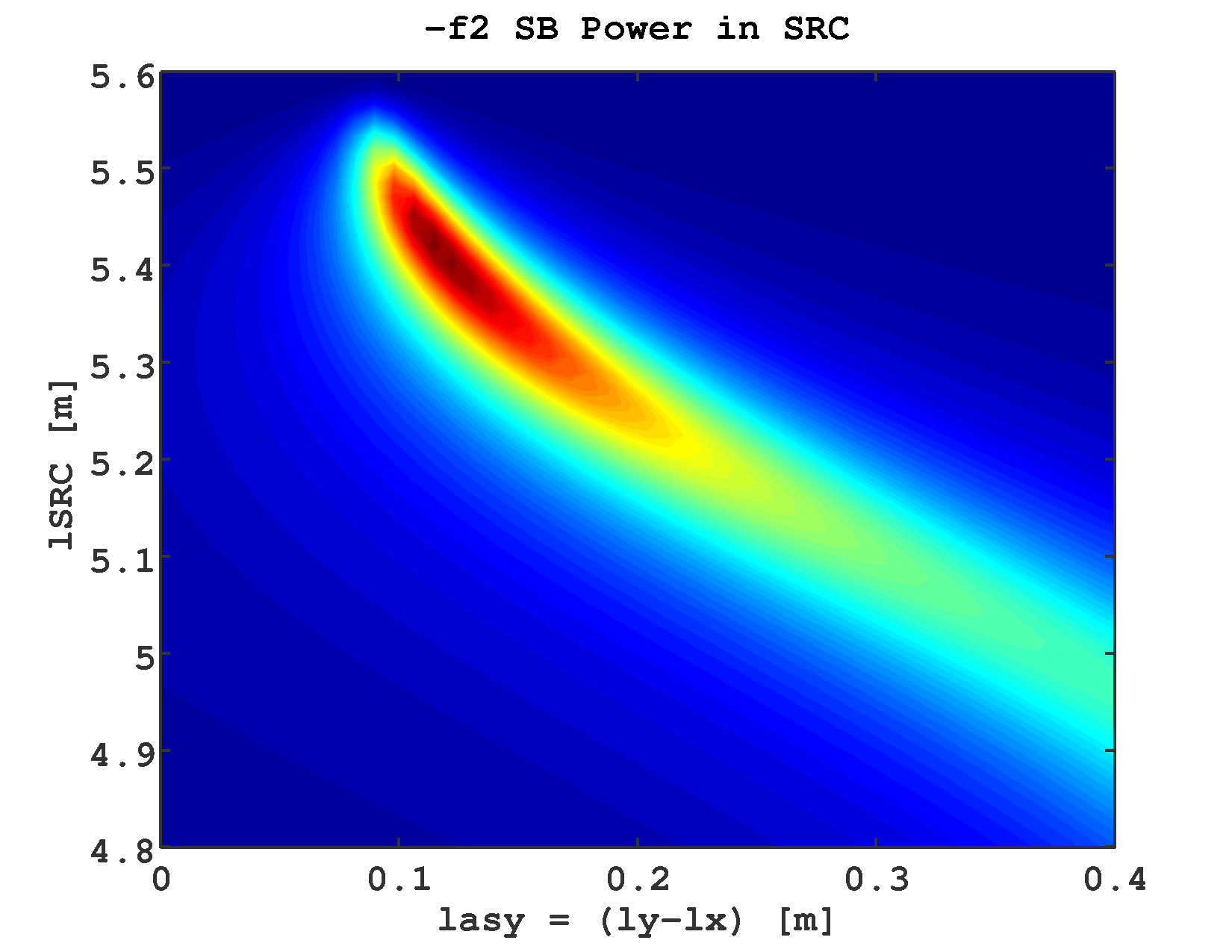
The solution was (in m): larm = 38.4; lSRC = 5.3657; lPRC = 6.7469; lASY = 0.0912;
After, when we looked at the RF power at the ports, we noticed that f2 was much stronger in POX than in POY (or maybe vice-versa, not sure anymore about that). It was evident that since we moved from the ideal configuration of the interferometer, the X and the Y arms started seeing two different cavities (think of the cavity made of the either ITM and the rest of the ifo). Although the upper and the lower sidebands were still equal for both f1 and f2, which means that detuning was not occurring.
Now we had to re-tune the parameters adding to the conditions in (3) also that the SBs' power was the same in lx and ly (the short michelson). We tried a new iterative process, hoping that it would converge to a solution:
- PRC length tuning to make f1 resonate in PRC
- lASY tuning to equalize the power in lx and ly
- SRC length tuning to maximise the power of f2 in SRC (we decided that f2 critical coupling the least important condition)
We found a solution at: larm = 38.4; lSRC = 5.4225; lPRC = 6.74668; lASY = 0.0568;
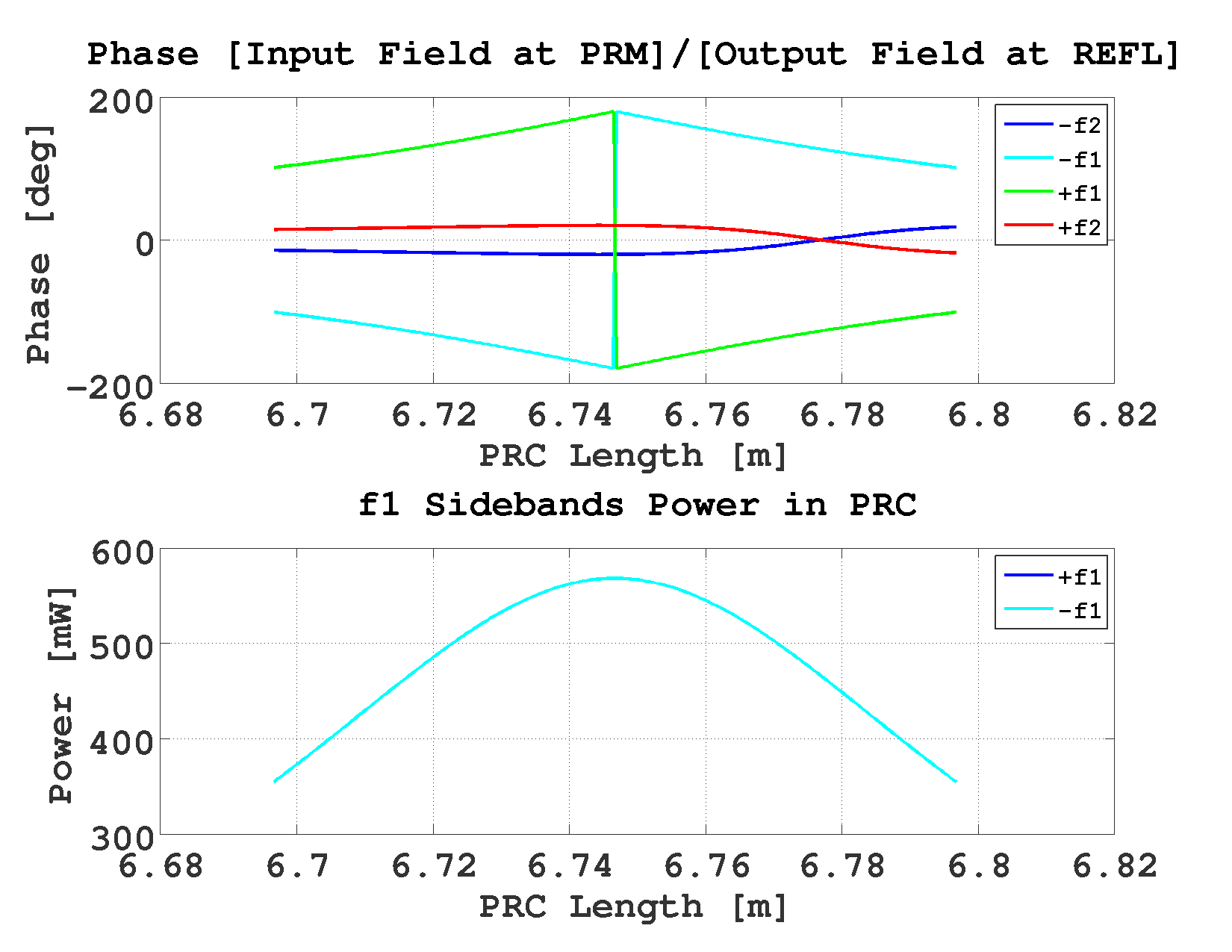
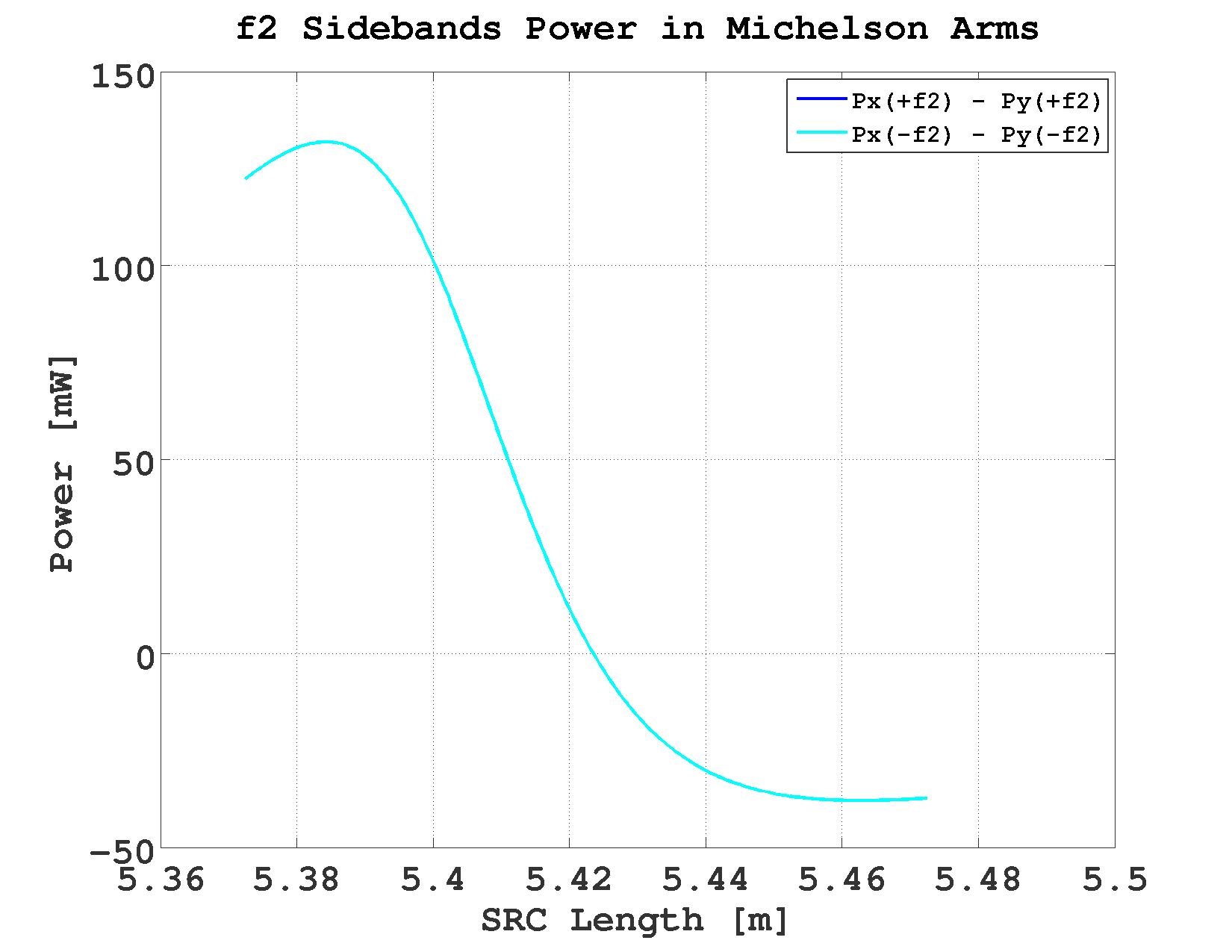
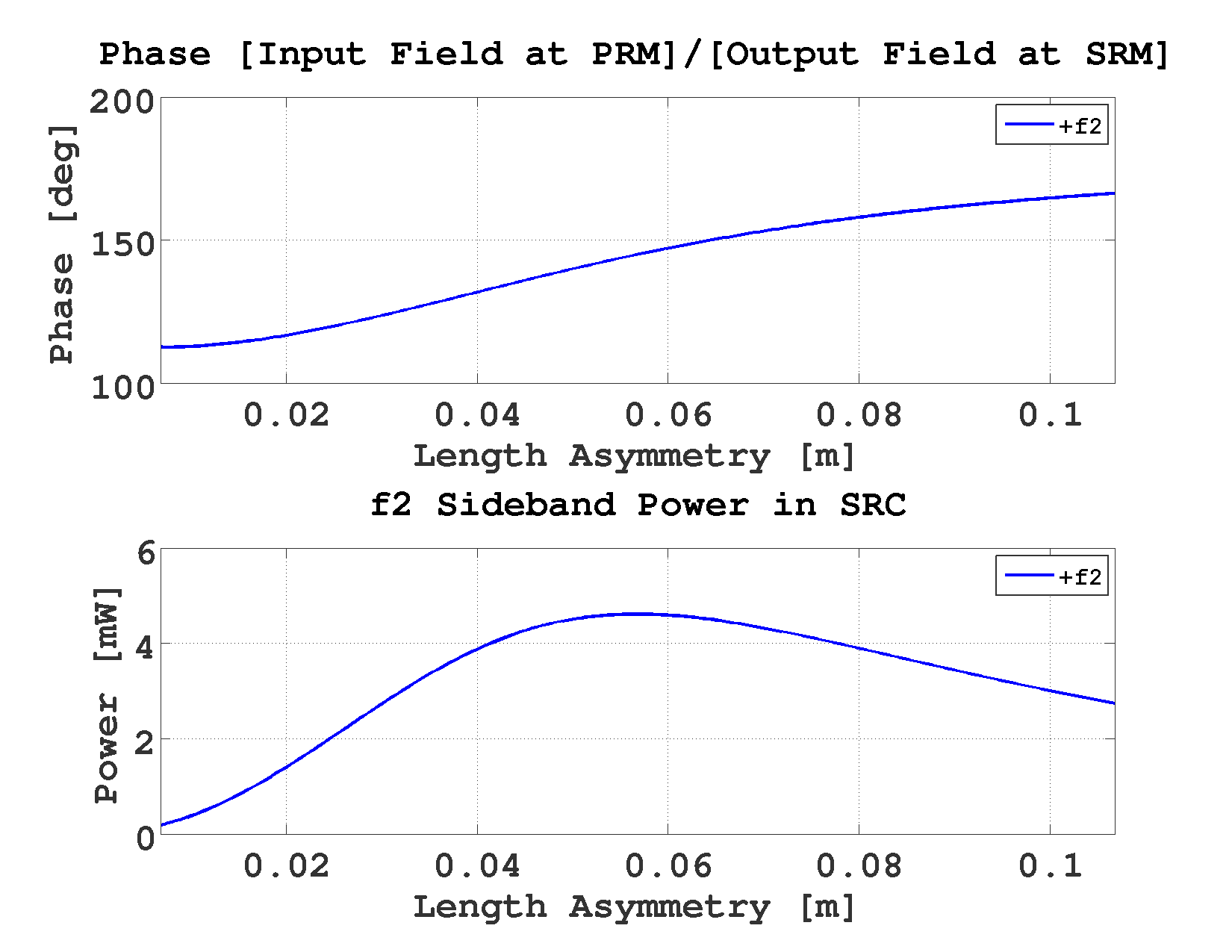
Recently we also looked at the 3f demodulation signals and we noticed that the 3f2 signals at the REFL port were somehow affected by the CARM offset - which would defeat the purpose of having the 3f. In particular, the lock points for PRCL and MICH move for a few nm when the cavity power builds up to 100%.


Just for an example, compare it with an improbable ideal optical design in which the arms are 47m long.


Looking at the reflectance of the full interferometer for the SB involed in the 3f2 demodulation (that is, +/-f2, +/-2*f2, +/-3*f2), it turns out f2 is not resonant.
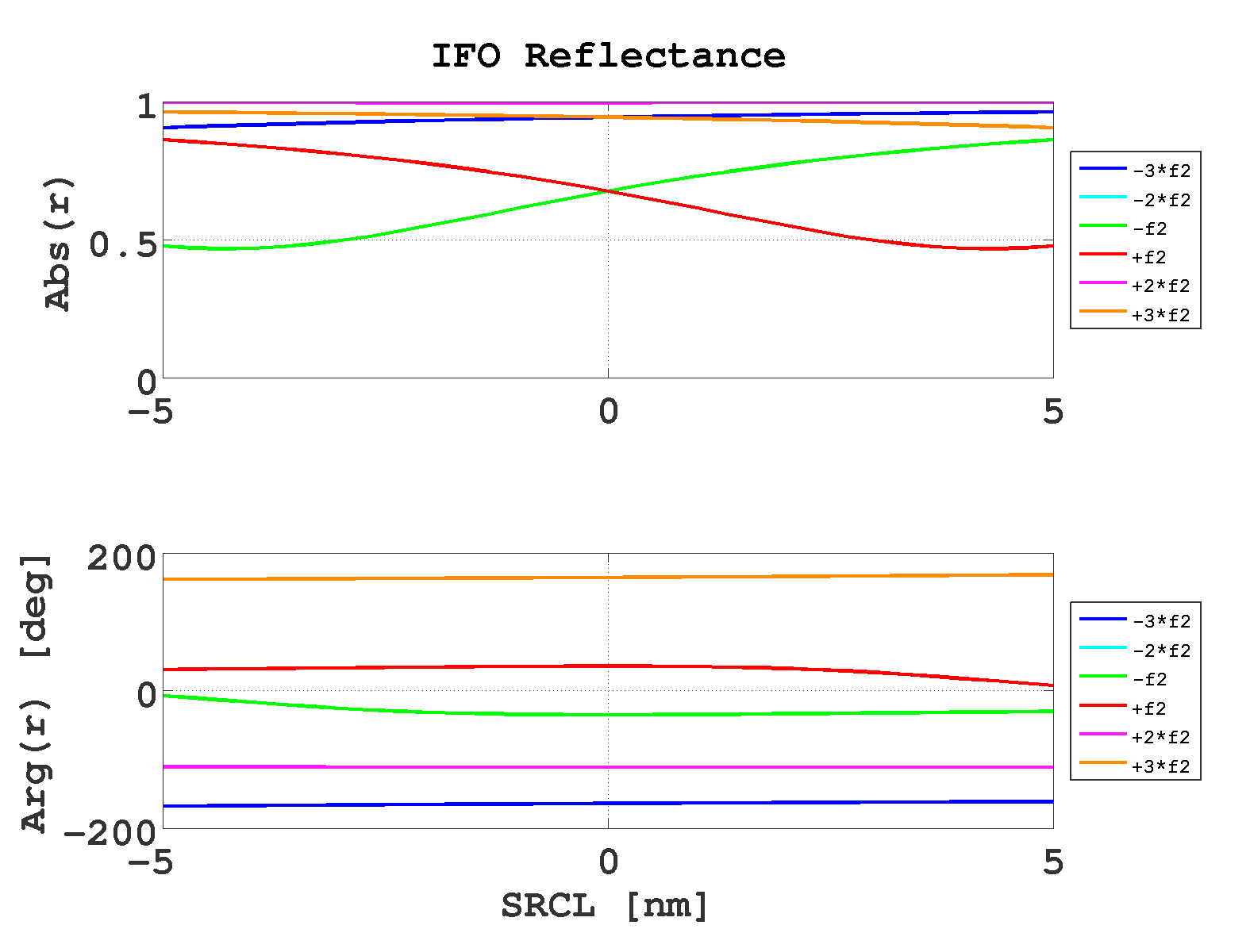
Reducing PRC of 0.0219 m, would make f2 resonate, but then there would be a difference of about 100mW in f2 between lx and ly.