
|
Size: 9031
Comment:
|
← Revision 168 as of 2012-03-11 03:31:49 ⇥
Size: 16069
Comment:
|
| Deletions are marked like this. | Additions are marked like this. |
| Line 3: | Line 3: |
| . ''''' To help the DRMI commissioning that will be performed at LLO.''''' | . ''''' To help the DRMI commissioning that will be performed at the sites.''''' |
| Line 5: | Line 6: |
| . In the aLIGO schedule ''''' a DRMI test will start on May 2012 at LLO. ''''' Prior to the DRMI test we, the 40m lab, should help their commissioning to make the things smooth and hence allow to finish the commissioning in the shortest time. Moreover any commissioning tests that will be performed at LLO should be well predicted and tested at the 40m so that the people at the site can easily pass through all the commissioning tests and possibly can spend time for a real trouble shooting (commissioning) to fix unexpected issues. . So for this purpose some recipes must be prepared by the 40m lab. Each recipe includes descriptions about how to make a commissioning test, how to estimate important parameters and the results at the 40m. Additionally some useful scripts must be developed at the 40m. [[BR]] [[BR]] <<TableOfContents(2)>> [[BR]] |
. In the aLIGO schedule ''''' the DRMI test will start around of May 2012 at LLO. ''''' The purpose of the 40m DRMI work is to produce a handbook of DRMI characterization which can be handed to the LLO people. This handbook will include the why, the howto, and the results for all of the DRMI characterization done here. In addition, we will deliver all of the scripts, screens, codes, etc. which are used to do these tests. The intention is to make the whole DRMI process, plug and play. The commissioning tests that will be performed at LLO should be tested at the 40m so that the people at the sites can easily do all the commissioning tests and spend their time on the difficult problems. <<BR>><<BR>><<TableOfContents(2)>><<BR>> |
| Line 14: | Line 13: |
| <<Anchor(plantop)>> | . <<Anchor(plantop)>> |
| Line 16: | Line 16: |
| ------ . {*} {*} {*} == Noise Budget == === Requirements === . Shot Noise . Dark (RFPD) Noise . ADC Noise . Laser Amplitude noise . Laser Frequency Noise . Oscillator Noises . DAC Noise . Coil Driver Noise . Seismic Noise . Loop cross-coupling (PRC -> MICH, PRC -> SRC, etc.) . Coupling from Angular motions (e.g., oplevs, osems) === How To === . pyNDS for data getting . Python based NB code (copy of matlab based eLIGO code) . CDS Oscillator/Lockin used for noise coupling measurements . CDS NoisePowerChop part for incoherent noise couplings === Results === * [[ Interferometer_Characterization/Michelson_Noise_Budget| Michelson Noise budget ]] * [[ Interferometer_Characterization/PRMI_Noise_Budget| PRMI Noise budget ]] * [[ Interferometer_Characterization/DRMI_Noise_Budget| DRMI Noise budget ]] * [[LentickleC1 | Link to the Lentickle C1 model]] <<BR>><<BR>> ------ . {*} {*} {*} |
|
| Line 18: | Line 53: |
| . {{{ Schnupp asymmetry = 0.0342 [m] +/- XXX [mm] }}} . The Schnupp asymmetry determines the reflectivity '' r ''and transmissivity '' t '' of the Michelson for the f1 and f2 sidebands when the carrier is kept in the dark condition. In the design ''' the f2 sideband should be critical coupling in the dual recycling cavity '''[#ref1 [1]] [#ref2 [2]]. To achieve the critical coupling we should adjust '' r '' and '' t'' properly. . There are several techniques to measure it without the arm cavities, for example look at [#ref3 [3]] . According to a simulation the asymmetry should be within the precision of XXX mm to achieve more than 95 % of the power build up. |
. {{{ Schnupp asymmetry = 3.42 [cm] +/- 0.3 [cm] }}} . The Schnupp asymmetry determines the reflectivity '' r ''and transmissivity '' t '' of the Michelson for the f1 and f2 sidebands when the carrier is kept in the dark condition. In the design ''' the f2 sideband should be critical coupling in the dual recycling cavity '''[[#ref1|[1]]] [[#ref2|[2]]]. To achieve the critical coupling we should adjust '' r '' and '' t'' properly by tuning the asymmetry. . According to a simulation the asymmetry should be within the precision of XXX mm to achieve more than 95 % of the maximum power build up. |
| Line 27: | Line 61: |
| . Here is an instruction how to measure the Schnupp asymmetry. === Results === . The result at the 40m was ... and the precision was +/- XXX mm. This implies us to fix the length of the asymmetry. [[BR]][[BR]] ------ |
. Here two example methods are introduced: . ''' (1) based on a measurement of the MICH transmissivity at frequency of AM sidebands''' [[#ref3|[3]]] . ''' (2) based on a measurement of the difference in the optical phase of each arm at frequency of PM sidebands (needs each FP cavity locked)''' [[#ref4|[4]]] . Since we've already been able to lock both FP arms the second method was performed to measure the asymmetry at the 40m. === Results === . Here is the result from the first measurement [[#ref4|[4]]] . {{{ Lsa = 3.64 [cm] ± 0.32 [cm] }}} <<BR>><<BR>> ------ <<Anchor(PRC length measurement)>> . {*} {*} {*} |
| Line 37: | Line 80: |
| . {{{ lprc = 6.7538 [m] +/- 3 [mm] }}} . In order to successfully lock a power recycled interferometer with Fabry-Perot arms a technique broadly used is to choose the PRC length such that the sidebands are resonate in PRC. In our design the PRC length has been chosen to let both f1 and f2 sidebands resonate in PRC [#ref1 [1]] [#ref2 [2]]. The precision required to get those sidebands resonate is simply depending on the linewidth of PRC for both sidebands. . As shown in the plot below the length must be adjusted within 3 mm precision to get more than 90 % of max build up for the f2 sideband. . attachment:PRClength_scan.png . ''' Fig.1 ''' An example plot of macroscopic PRC length scan and the intracavity power. . /!\ ''''' This plot is too naive because doesn't include the effects from FP arms and SRC. Will be updated soon''''' . There are several techniques to measure the absolute length of a cavity. Here are the references [#ref2 [2]] [#ref3 [3] ] [#ref4 [4]] |
. /!\ ''''' The required precision should be reviewed also from point of view of the sensing matrix ''''' . {{{ lprc = 6.7538 [m] +/- 3 [mm] }}} . In order to successfully lock a power recycled interferometer with Fabry-Perot arms a technique broadly used is to choose the PRC length such that the sidebands resonate in PRC. In our design the PRC length has been chosen to let both f1 and f2 sidebands resonate in PRC [[#ref1|[1]]] [[#ref2|[2]]]. The precision required to get those sidebands resonate is simply depending on the linewidth of PRC for both sidebands. . As shown in the plot below the length must be adjusted within 3 mm precision to get more than 90 % of max build up for both sidebands. . {{attachment:PRClength_scan.png}} . ''' Fig.1 ''' An example plot of macroscopic PRC length scan and the intracavity power. |
| Line 51: | Line 91: |
| . There are two options to measure the PRC length. One is to use another auxiliary laser and the other is to sweep the modulation frequency. === Results === . [[BR]][[BR]] ------ |
. There are two major methods to measure the PRC length: . '''(1) A technique uses another auxiliary laser to scan the frequency.''' . '''(2) To sweep the sidebands' frequency. ''' . There are several techniques to measure the absolute length of a cavity. Here are the references [[#ref2|[2]]] [[#ref5|[5]] ] [[#ref6|[6]]][[#ref7|[7]]] === Results === . <<BR>><<BR>> ------ . {*} {*} {*} |
| Line 60: | Line 105: |
| . {{{ lsrc = 5.39915 [m] +/- 1.5 cm }}} . Similar to the PRC length, the f2 sidebands should resonate in SRC to get cleaner signal [#ref1 [1]]. According to the linewidth of SRC for the f2 sidebands the length should be something. |
. /!\ ''''' The required precision should be reviewed also from the point of view of the sensing matrix ''''' . {{{ lsrc = 5.39915 [m] +/- 1.5 cm }}} . Similar to the PRC length, the f2 sidebands should resonate in SRC to get cleaner signal [[#ref1|[1]]]. According to the linewidth of SRC for the f2 sidebands the tolerance of the length can be determined. |
| Line 64: | Line 110: |
. attachment:SRClength_scan.png . ''' Fig.2 ''' An example plot of macroscopic SRC length scan and the intracavity power. . /!\ ''''' This plot is too naive because doesn't include the effects from FP arms and PRC. Will be updated soon''''' |
. {{attachment:SRClength_scan.png}} . ''' Fig.2 ''' An example plot of macroscopic SRC length scan and the intracavity power. |
| Line 72: | Line 115: |
| . === Results === . [[BR]][[BR]] ------ |
. [[#PRC|Essentially the same as the PRC length measurement]] === Results === . <<BR>><<BR>> ------ . {*} {*} |
| Line 82: | Line 126: |
| Carrirer = XX f1 sideband = YY f2 sideband = ZZ }}} |
Carrirer = XX f1 sideband = YY f2 sideband = ZZ }}} |
| Line 91: | Line 131: |
=== How to === . === Results === . {{{ Carrirer = XX f1 sideband = YY f2 sideband = ZZ |
=== How to === . Carrier recycling gain measurement with POP (POX/POY) . lock MICH and measure the amount of beam at POP . lock Power-Recycled Michelson and align the cavity . measure POP again and the ratio between that with and without PRCL gives you the recycling gain . Sidebands recycling gain measurement . do the same things and measure the gain at each frequency using Optical Spectrum Analyzer (OSA) === Results === . {{{ Carrirer = XX f1 sideband = YY f2 sideband = ZZ }}} <<BR>><<BR>> ------ . {*} {*} == Tuning of Locking protocol == === Requirements === . The lock of DRMI has to be robust and repeatable. Some threshold values and initial gains should be tuned to routinely acquire the lock. . In addition to those, the boost filters should be triggered at appropriate timing and by appropriate thresholds. === How to === . Locking of MICH will be triggered if the ASDC signal goes to MMM% of the max power. . Locking of PRC will be triggered when 2 x f1 signal goes above XXX in AAA port. . Locking of SRC will be triggered when 2 x f2 signal goes above MMM in AAA port. . Boost filters will be on if YYY signals goes above MMM === Notes === . MICH is controlled such that the amount of carrier going to AS becomes zero. So the MICH control should be triggered when ASDC goes below a certain value. . If PRC is locked the AM sideband at 2 x f1 and 2 x f2 will resonate. . If SRC is locked the AM sideband at 2 x f2 will resonate. <<BR>><<BR>> ------ . {*} {*} == Sensing Matrix Verification == === Expected matrix from Optickle === === How to === . At first the ITMs must be balanced at a particular frequency so that one can excite purely the MICH DOF. . Measure the TF matrix between all mirrors LSC_EXC and the RFPD I&Q signals. . Compare with Optickle-based matrix. . Use matrix residuals as another handle on optical plant imperfections. === Results === . <<BR>><<BR>> ------ == Measurement of Spot Positions in DRMI == . {*} === Requirements === . {{{ off-centering on each optic < 2 mm }}} === How to === . Use the standard A2L technique after coils are balanced. === results === . {{{ YAW = XXX mm PIT = XXX mm }}} <<BR>><<BR>> ------ . {*} == Reflectivity check == === Expected values === . {{{ REFL = XXX (when PRMI, carrier locked) REFL = XXX (when PRMI, sidebands locked) REFL = XXX (when DRMI) }}} . This test is useful for finding a mismatch in the mode matchings === How to === . Measure the light power coming into a PD at the REFL port. === Results === . {{{ REFL = XXX (when PRMI, carrier locked) REFL = XXX (when PRMI, sidebands locked) REFL = XXX (when DRMI) }}} <<BR>><<BR>> ------ . {*} == Calibration of Actuator responses == . In the process of the noise budgeting one has to measure the MIMO closed-loop transfer functions. For this purpose, the calibration of actuators on BS, ITMs, PRM and SRM are necessary. Unlike the optical gains, the actuator responses shouldn't vary, therefore the use of the actuator responses as references in estimation of the noise budget is fairly reliable. === How to === . '''Free-Swinging Michelson Bootstrap'''. Once the estimation of the optical gain is done, the BS and ITMs can be calibrated. [[#ref8|[8]]] [[#ref9|[9]]]. . After the calibration of the BS and ITMs, the PRM and SRM can be calibrated by referencing them to the ITMs in the DRMI configuration. . In summary here is the steps to calibrate the responses . {{{ 1. Calibration of the Michelson sensor 2. Calibration of the BS and ITMs actuators 3. Calibration of the PRC sensor and the PRM actuator response 4. Calibration of the SRC sensor and the SRM actuator response }}} . Comparison of measured actuation coefficients with analytic estimates. === Results === {{attachment:calib_actuators.png }} . See [[#ref9|[9]]] for the details . {{{ BS = 2.190e-08 / f^2 [m/counts] ITMX = 4.913e-09 / f^2 [m/counts] ITMY = 4.832e-09 / f^2 [m/counts] PRM = 2.022e-08 / f^2 [m/counts] SRM = 2.477e-08 / f^2 [m/counts] }}} <<BR>> . Our DAC have +/-5V single ended outputs with 16 bit resolution. Therefore the DACs conversion factor is 10V/2^16 counts = 0.000152587890625 [V/counts]. With this DAC factor, we obtain the following actuator responses. . {{{ BS = 138.21 / f^2 [um/V] ITMX = 32.20 / f^2 [um/V] ITMY = 31.67 / f^2 [um/V] PRM = 162.33 / f^2 [um/V] |
| Line 100: | Line 248: |
| [[BR]][[BR]] ------ == Beam centering and measurement of spot position on BS == === Requirements === {{{ off-centering on each optics < XXX mm |
<<BR>><<BR>> ------ . {*} == Diagonalization of LSC Output Matrix into the Canonical DOF basis == === Requirements === . {{{ Precision < 5% }}} . We want the LSC system to be diagonal to minimize weird loop effects around the UGF. === How to === . Measure sensing matrix. . Invert. <<BR>><<BR>> ------ . {*} == F2A filter adjustment == === Requirement === . {{{ Precision < 0.25 % }}} . Pushing a suspension longitudinally cause a misalignment because of the inherent force to torque coupling in a suspended mirror [[#ref10|[10]]] and also because of the imperfections in the suspensions construction and actuation coefficients. === How to === . We will use a version of the eLIGO F2A scripts that utilizes the LOCKIN modules inside of the suspension screens (no AWG or ezlockin/TDS issues). . An instructions === Results === . High frequency coil balancing successful. Estimated balancing accuracy is NN% . Low frequency suspension balancing successful. Estimated balancing accuracy is NN% <<BR>><<BR>> ------ . {*} {*} {*} {*} {*} {*} {*} == 3f locking test == === Requirements === . Since 3f locking doesn't use the carrier light the signal level is generally small. Therefore one has to make sure the SNR are big enough to robustly keep DRMI on resonance. === How to === . Noise budgeting . Sensing matrix === Optickle simulations === {{attachment:CARMoffset_vs_MICH.gif}} === Results === <<BR>><<BR>> ------ . {*} {*} == Modulation Depth Measurements == === How to === . Set up some OSAs === Results === . An OSA was installed on the REFL path. The measurement has been done when all the mirrors except PRM were intentionally misaligned. In this condition the direct reflection from PRM goes to the OSA without having any interferences. . {{ attachment:OSA_REFL.png }} . {{{ LO frequency = 11065910 Hz Gamma@11MHz = 0.136 [rad] Gamma@55MHz = 0.1572 [rad] |
| Line 108: | Line 316: |
| === How to === === results === . {{{ YAW = XXX mm PIT = XXX mm |
|| ||''' -55 MHz ''' ||''' -11 MHz '''|| ''' Carrier ''' || ''' +11 MHz ''' ||'''+55 MHz''' || ||''' Peak height [V]''' || 1.2838 || 0.961753 || 203.7 || 0.955951 || 1.283775 || . To estimate the modulation depth, the following equation was used : . {{{ Gamma = sqrt( 4R / (1+2R) ), where R=[peak height of a SB] / [carrier's peak height] |
| Line 113: | Line 324: |
[[BR]][[BR]] ------ == Reflectivity check == === How to === === Results === [[BR]][[BR]] ------ == Sensing matrix check == === How to === === Results === [[BR]][[BR]] ------ == Calibration of Actuator responses == === How to === === Results === [[BR]][[BR]] ------ == Diagonalization of Length Sensing and Controls == === Requirements === . {{{ Precision < 1 % (?) }}} . When the DRMI is locked the MICH control signal is fed back to the BS actuator, but the actuation on BS intrinsically changes the PRC and SRC length as well as the MICH length ('' lx-ly''). This means the noise from MICH can be transferred to the PRC and SRC, resulting in the degradation of noise performance in the PRC and SRC [#ref3 [3]]. . To avoid the coupling the MICH control should also actuate on PRM and SRM to minimize the coupling. === How to === [[BR]] [[BR]] ------ == f2a filter adjustment == === Requirement === . {{{ Precision < XX % }}} . Pushing a suspension to the length direction cause a misalignment. === How to === . There is a script that measures the f2a ratio and apply filters to cancel them. === Results === [[BR]][[BR]] ------ == Length Noise budgeting == === Requirements === . === How to === . Suspension noise . Laser amplitude noise . Electronics noise (including ADC and DAC) . Coupling from Angular motions === Results === [[BR]][[BR]] ------ == Angular Motion Noise budgeting == === Requirements === . === How to === . Optimize control loops (local damping, OPLEVs and WFSs) . Suspension noise . Electronics noise (including ADC and DAC) === Results === [[BR]][[BR]] ------ == 3f locking test == === Requirements === . === How to === . === Results === [[BR]][[BR]] [[BR]][[BR]] [[BR]][[BR]] -------- = Sub-tasks = == Tuning of Locking protocol == === How to === . Threshold values for the triggered locking . Schmit triggers . Auto locking scripts [[BR]][[BR]] ------ |
<<BR>><<BR>> ------ . {*} {*} {*} |
| Line 213: | Line 331: |
| . There are several tools that can model and simulate interferometers in numerical ways. Here we introduce two major tools; ''' finesse ''' [#ref4 [4] ]and ''' Optickle '''. . [[IFO Modeling|See this page for details]] [[BR]][[BR]] [[BR]] [[BR]] |
. Any kinds of measurements listed here must be verified by a simulation. . There are several tools that can model and simulate interferometers in numerical ways. For example: ''' finesse ''' [[#ref11|[11]] ], ''' Optickle ''', ''' Looptickle ''' and '''Lentickle '''. . [[IFO_Modeling|See this page for details]] <<BR>><<BR>><<BR>><<BR>> ------ == Regular EVO meeting == [[DRMI meeting |Meeting summary page]] <<BR>><<BR>><<BR>><<BR>> |
| Line 222: | Line 346: |
| [1] R.Abbott et al, " ''''' Advanced LIGO Length Sensing and Control Final Design''''' "[https://dcc.ligo.org/cgi-bin/private/DocDB/ShowDocument?docid=12213 LIGO-T1000298-v2 (2010)] <<Anchor(ref2)>> [2] A.Stochino, " ''''' Design and Characterization of Optical Cavities and Length Sensing and Control System of an Advanced Gravitational Wave Interferometer ''''' " [https://nodus.ligo.caltech.edu:30889/svn/trunk/alberto/thesis/main/main.pdf 40m svn (2010)] |
[1] R.Abbott et al, " ''''' Advanced LIGO Length Sensing and Control Final Design''''' "[[https://dcc.ligo.org/cgi-bin/private/DocDB/ShowDocument?docid=12213|LIGO-T1000298-v2 (2010)]] <<Anchor(ref2)>> [2] A.Stochino, " ''''' Design and Characterization of Optical Cavities and Length Sensing and Control System of an Advanced Gravitational Wave Interferometer ''''' " [[https://nodus.ligo.caltech.edu:30889/svn/trunk/alberto/thesis/main/main.pdf|40m svn (2010)]] |
| Line 228: | Line 352: |
| [3] O.Miyakawa on old 40m Elog attachment:osamu_elog.png <<Anchor(ref3)>> [3] R.ward, " ''''' Length Sensing and Control of an Advanced Prototype Interferometric Gravitational Wave Detector''''' "[https://dcc.ligo.org/cgi-bin/private/DocDB/ShowDocument?docid=9237 PhD Thesis LIGO-P1000018-v1 (2010)] |
[3] O.Miyakawa, " ''''' Michelson asymmetry length ''''' " old 40m Elog (2004) {{attachment:osamu_elog.png}} |
| Line 235: | Line 355: |
| [4] M.Rakhmanov et al, " ''''' Characterization of the LIGO 4km Fabry-Perot cavities via their high-frequency dynamic response to length and frequency variations ''''' " [http://iopscience.iop.org/0264-9381/21/5/015/ CQG (2004)] | [4] J.Rollins, " ''''' Schnupp asymmetry measurement ''''' " [[http://nodus.ligo.caltech.edu:8080/40m/4821|40m elog #4821 (2011)]] |
| Line 238: | Line 358: |
| [5] A.Araya et al, " ''''' Absolute-length determination of a long-baseline Fabry-Perot cavity by means of resonating modulation sidebands ''''' " [http://www.opticsinfobase.org/abstract.cfm?URI=ao-38-13-2848 Applied optics (1999)] | [5] M.Rakhmanov et al, " ''''' Characterization of the LIGO 4km Fabry-Perot cavities via their high-frequency dynamic response to length and frequency variations ''''' " [[http://iopscience.iop.org/0264-9381/21/5/015/|CQG (2004)]] |
| Line 241: | Line 361: |
| [6] M.Rakhmanov et al, " ''''' An optical vernier technique for in situ measurement of the length of long Fabry-Perot cavities ''''' " [http://iopscience.iop.org/0957-0233/10/3/013/ Meas.Sci.Technol (1999)] |
[6] A.Araya et al, " ''''' Absolute-length determination of a long-baseline Fabry-Perot cavity by means of resonating modulation sidebands ''''' " [[http://www.opticsinfobase.org/abstract.cfm?URI=ao-38-13-2848|Applied optics (1999)]] |
| Line 245: | Line 364: |
| [7] A.Freise and K.Strain, " '''''Interferometer Techniques for Gravitational-Wave Detection ''''' "[http://relativity.livingreviews.org/Articles/lrr-2010-1/ Living Review (2010)] [[BR]] [[BR]] [#plantop back to top] |
[7] M.Rakhmanov et al, " ''''' An optical vernier technique for in situ measurement of the length of long Fabry-Perot cavities ''''' " [[http://iopscience.iop.org/0957-0233/10/3/013/|Meas.Sci.Technol (1999)]] <<Anchor(ref8)>> [8] R.ward, " ''''' Length Sensing and Control of an Advanced Prototype Interferometric Gravitational Wave Detector''''' "[[https://dcc.ligo.org/cgi-bin/private/DocDB/ShowDocument?docid=9237|PhD Thesis LIGO-P1000018-v1 (2010)]] <<Anchor(ref9)>> [9] K.Izumi, " ''''' Calibration of actuators : BS, ITMX and ITMY ''''' " [[http://nodus.ligo.caltech.edu:8080/40m/4721|40m elog #4721]] <<Anchor(ref10)>> [10] P.Fritschel, " ''''' Digital Suspension Filter Design ''''' "[[http://www.ligo.caltech.edu/docs/T/T010140-01.pdf,|LIGO-T010140-01(2001)]] <<Anchor(ref11)>> [11] V.Mandik, old elog entry (2004) {{attachment:f2a_ilog.png}} <<Anchor(ref12)>> [12] A.Freise and K.Strain, " '''''Interferometer Techniques for Gravitational-Wave Detection ''''' "[[http://relativity.livingreviews.org/Articles/lrr-2010-1/|Living Review (2010)]] <<BR>><<BR>>[[#plantop|back to top]] |
Interferometer Characterization at the 40m prototype
Goals
To help the DRMI commissioning that will be performed at the sites.
Motivations
In the aLIGO schedule the DRMI test will start around of May 2012 at LLO.
The purpose of the 40m DRMI work is to produce a handbook of DRMI characterization which can be handed to the LLO people. This handbook will include the why, the howto, and the results for all of the DRMI characterization done here. In addition, we will deliver all of the scripts, screens, codes, etc. which are used to do these tests. The intention is to make the whole DRMI process, plug and play. The commissioning tests that will be performed at LLO should be tested at the 40m so that the people at the sites can easily do all the commissioning tests and spend their time on the difficult problems.
Contents
- Interferometer Characterization at the 40m prototype
-
Plan for DRMI Characterization at the 40m
- Noise Budget
- Schnupp asymmetry measurement and its adjustment
- PRC length measurement and its adjustment
- SRC length measurement and its adjustment
- Recycling gain measurements
- Tuning of Locking protocol
- Sensing Matrix Verification
- Measurement of Spot Positions in DRMI
- Reflectivity check
- Calibration of Actuator responses
- Diagonalization of LSC Output Matrix into the Canonical DOF basis
- F2A filter adjustment
- 3f locking test
- Modulation Depth Measurements
- IFO modeling
- Regular EVO meeting
- References
Plan for DRMI Characterization at the 40m

Noise Budget
Requirements
- Shot Noise
- Dark (RFPD) Noise
- ADC Noise
- Laser Amplitude noise
- Laser Frequency Noise
- Oscillator Noises
- DAC Noise
- Coil Driver Noise
- Seismic Noise
Loop cross-coupling (PRC -> MICH, PRC -> SRC, etc.)
- Coupling from Angular motions (e.g., oplevs, osems)
How To
- pyNDS for data getting
- Python based NB code (copy of matlab based eLIGO code)
- CDS Oscillator/Lockin used for noise coupling measurements
CDS NoisePowerChop part for incoherent noise couplings
Results
Schnupp asymmetry measurement and its adjustment
Requirement
Schnupp asymmetry = 3.42 [cm] +/- 0.3 [cm]
The Schnupp asymmetry determines the reflectivity r and transmissivity t of the Michelson for the f1 and f2 sidebands when the carrier is kept in the dark condition. In the design the f2 sideband should be critical coupling in the dual recycling cavity [1] [2]. To achieve the critical coupling we should adjust r and t properly by tuning the asymmetry.
- According to a simulation the asymmetry should be within the precision of XXX mm to achieve more than 95 % of the maximum power build up.
How to measure
- Here two example methods are introduced:
- Since we've already been able to lock both FP arms the second method was performed to measure the asymmetry at the 40m.
Results
Here is the result from the first measurement [4]
Lsa = 3.64 [cm] ± 0.32 [cm]
PRC length measurement and its adjustment
Requirements
 The required precision should be reviewed also from point of view of the sensing matrix
 lprc = 6.7538 [m] +/- 3 [mm]
In order to successfully lock a power recycled interferometer with Fabry-Perot arms a technique broadly used is to choose the PRC length such that the sidebands resonate in PRC. In our design the PRC length has been chosen to let both f1 and f2 sidebands resonate in PRC [1] [2]. The precision required to get those sidebands resonate is simply depending on the linewidth of PRC for both sidebands.
- As shown in the plot below the length must be adjusted within 3 mm precision to get more than 90 % of max build up for both sidebands.
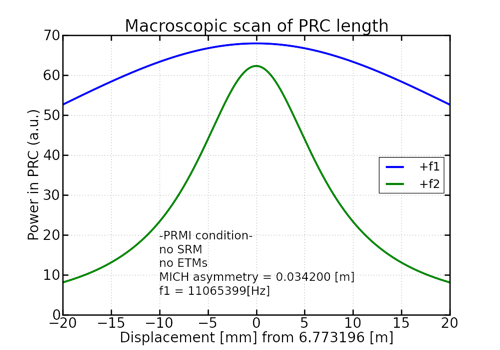
Fig.1 An example plot of macroscopic PRC length scan and the intracavity power.
How to measure
- There are two major methods to measure the PRC length:
(1) A technique uses another auxiliary laser to scan the frequency.
(2) To sweep the sidebands' frequency.
There are several techniques to measure the absolute length of a cavity. Here are the references [2] [5 ] [6][7]
Results
SRC length measurement and its adjustment
Requirements
- The required precision should be reviewed also from the point of view of the sensing matrix
lsrc = 5.39915 [m] +/- 1.5 cm
Similar to the PRC length, the f2 sidebands should resonate in SRC to get cleaner signal [1]. According to the linewidth of SRC for the f2 sidebands the tolerance of the length can be determined.
- As shown in the plot below the length must be adjusted within 1.5 cm precision to get more than 90 % of max build up for the f2 sideband.
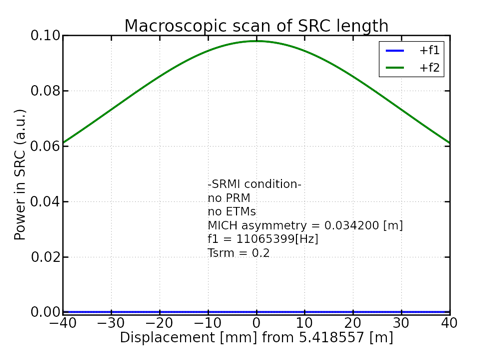
Fig.2 An example plot of macroscopic SRC length scan and the intracavity power.
How to measure
Results
Recycling gain measurements
Design
Carrirer = XX f1 sideband = YY f2 sideband = ZZ
- Since the recycling gain is related to loss in the recycling cavity, measuring the recycling gain tells us the amount of loss in the recycling cavity. The usual amount of loss is expected to be XX ppm per round trip. If we find unacceptably big loss, it might be due to a clipping or some obvious loss.
- In addition to the gain of the carrier light, the recycling gain of f1 and f2 tells us the reflectivity of the Michelson which is determined by the Schnupp asymmetry.
How to
- Carrier recycling gain measurement with POP (POX/POY)
- lock MICH and measure the amount of beam at POP
- lock Power-Recycled Michelson and align the cavity
- measure POP again and the ratio between that with and without PRCL gives you the recycling gain
- Sidebands recycling gain measurement
- do the same things and measure the gain at each frequency using Optical Spectrum Analyzer (OSA)
Results
Carrirer = XX f1 sideband = YY f2 sideband = ZZ
Tuning of Locking protocol
Requirements
- The lock of DRMI has to be robust and repeatable. Some threshold values and initial gains should be tuned to routinely acquire the lock.
- In addition to those, the boost filters should be triggered at appropriate timing and by appropriate thresholds.
How to
- Locking of MICH will be triggered if the ASDC signal goes to MMM% of the max power.
- Locking of PRC will be triggered when 2 x f1 signal goes above XXX in AAA port.
- Locking of SRC will be triggered when 2 x f2 signal goes above MMM in AAA port.
- Boost filters will be on if YYY signals goes above MMM
Notes
- MICH is controlled such that the amount of carrier going to AS becomes zero. So the MICH control should be triggered when ASDC goes below a certain value.
- If PRC is locked the AM sideband at 2 x f1 and 2 x f2 will resonate.
- If SRC is locked the AM sideband at 2 x f2 will resonate.
Sensing Matrix Verification
Expected matrix from Optickle
How to
- At first the ITMs must be balanced at a particular frequency so that one can excite purely the MICH DOF.
Measure the TF matrix between all mirrors LSC_EXC and the RFPD I&Q signals.
- Compare with Optickle-based matrix.
- Use matrix residuals as another handle on optical plant imperfections.
Results
Measurement of Spot Positions in DRMI
Requirements
off-centering on each optic < 2 mm
How to
- Use the standard A2L technique after coils are balanced.
results
YAW = XXX mm PIT = XXX mm
Reflectivity check
Expected values
REFL = XXX (when PRMI, carrier locked) REFL = XXX (when PRMI, sidebands locked) REFL = XXX (when DRMI)
- This test is useful for finding a mismatch in the mode matchings
How to
- Measure the light power coming into a PD at the REFL port.
Results
REFL = XXX (when PRMI, carrier locked) REFL = XXX (when PRMI, sidebands locked) REFL = XXX (when DRMI)
Calibration of Actuator responses
- In the process of the noise budgeting one has to measure the MIMO closed-loop transfer functions. For this purpose, the calibration of actuators on BS, ITMs, PRM and SRM are necessary. Unlike the optical gains, the actuator responses shouldn't vary, therefore the use of the actuator responses as references in estimation of the noise budget is fairly reliable.
How to
Free-Swinging Michelson Bootstrap. Once the estimation of the optical gain is done, the BS and ITMs can be calibrated. [8] [9].
- After the calibration of the BS and ITMs, the PRM and SRM can be calibrated by referencing them to the ITMs in the DRMI configuration.
- In summary here is the steps to calibrate the responses
  1. Calibration of the Michelson sensor
  2. Calibration of the BS and ITMs actuators
  3. Calibration of the PRC sensor and the PRM actuator response
  4. Calibration of the SRC sensor and the SRM actuator response
- In summary here is the steps to calibrate the responses
- Comparison of measured actuation coefficients with analytic estimates.
Results
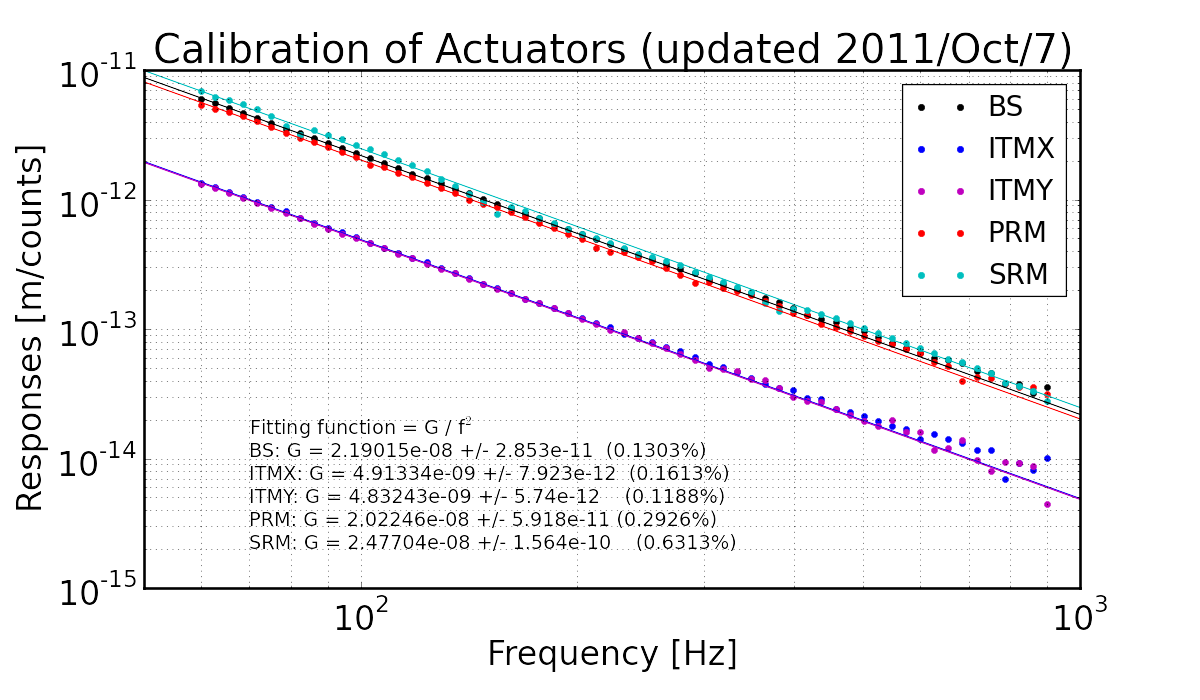
See [9] for the details
     BS = 2.190e-08 / f^2     [m/counts]
     ITMX  = 4.913e-09 / f^2   [m/counts]
     ITMY  = 4.832e-09 / f^2   [m/counts]
     PRM   = 2.022e-08 / f^2  [m/counts]
     SRM   = 2.477e-08 / f^2  [m/counts]
- Our DAC have +/-5V single ended outputs with 16 bit resolution. Therefore the DACs conversion factor is 10V/2^16 counts = 0.000152587890625 [V/counts]. With this DAC factor, we obtain the following actuator responses.
     BS   =  138.21 / f^2 [um/V]
     ITMX =  32.20 / f^2 [um/V]
     ITMY =  31.67 / f^2 [um/V]
     PRM  =  162.33 / f^2 [um/V]
Diagonalization of LSC Output Matrix into the Canonical DOF basis
Requirements
Precision < 5%
- We want the LSC system to be diagonal to minimize weird loop effects around the UGF.
How to
- Measure sensing matrix.
- Invert.
F2A filter adjustment
Requirement
Precision < 0.25 %
Pushing a suspension longitudinally cause a misalignment because of the inherent force to torque coupling in a suspended mirror [10] and also because of the imperfections in the suspensions construction and actuation coefficients.
How to
- We will use a version of the eLIGO F2A scripts that utilizes the LOCKIN modules inside of the suspension screens (no AWG or ezlockin/TDS issues).
- An instructions
Results
- High frequency coil balancing successful. Estimated balancing accuracy is NN%
- Low frequency suspension balancing successful. Estimated balancing accuracy is NN%
3f locking test
Requirements
- Since 3f locking doesn't use the carrier light the signal level is generally small. Therefore one has to make sure the SNR are big enough to robustly keep DRMI on resonance.
How to
- Noise budgeting
- Sensing matrix
Optickle simulations
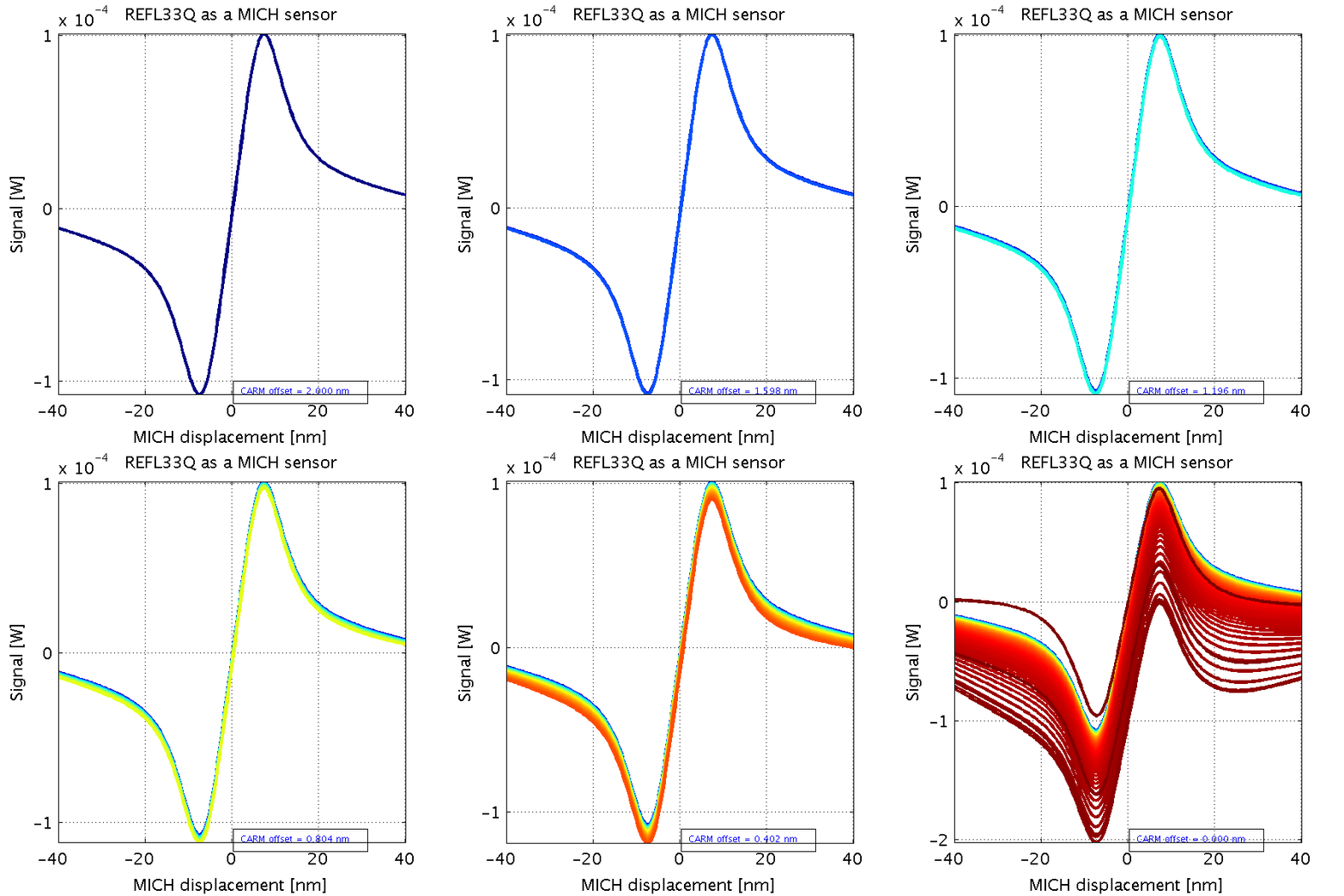
Results
Modulation Depth Measurements
How to
- Set up some OSAs
Results
- An OSA was installed on the REFL path. The measurement has been done when all the mirrors except PRM were intentionally misaligned. In this condition the direct reflection from PRM goes to the OSA without having any interferences.
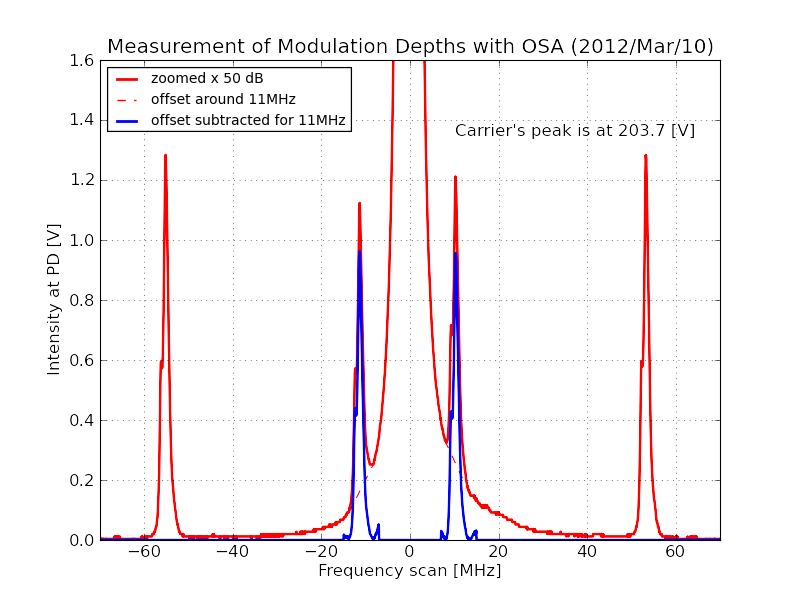
  LO frequency = 11065910 Hz
  Gamma@11MHz = 0.136 [rad]
  Gamma@55MHz = 0.1572 [rad]
-55 MHz
-11 MHz
Carrier
+11 MHz
+55 MHz
Peak height [V]
1.2838
0.961753
203.7
0.955951
1.283775
- To estimate the modulation depth, the following equation was used :
     Gamma = sqrt( 4R / (1+2R) ),
     where R=[peak height of a SB] / [carrier's peak height]
IFO modeling
How to
- Any kinds of measurements listed here must be verified by a simulation.
There are several tools that can model and simulate interferometers in numerical ways. For example: finesse [11 ], Optickle , Looptickle and Lentickle .
Regular EVO meeting
References
[1] R.Abbott et al, " Advanced LIGO Length Sensing and Control Final Design "LIGO-T1000298-v2 (2010)
[2] A.Stochino, " Design and Characterization of Optical Cavities and Length Sensing and Control System of an Advanced Gravitational Wave Interferometer " 40m svn (2010)
[3] O.Miyakawa, " Michelson asymmetry length " old 40m Elog (2004) 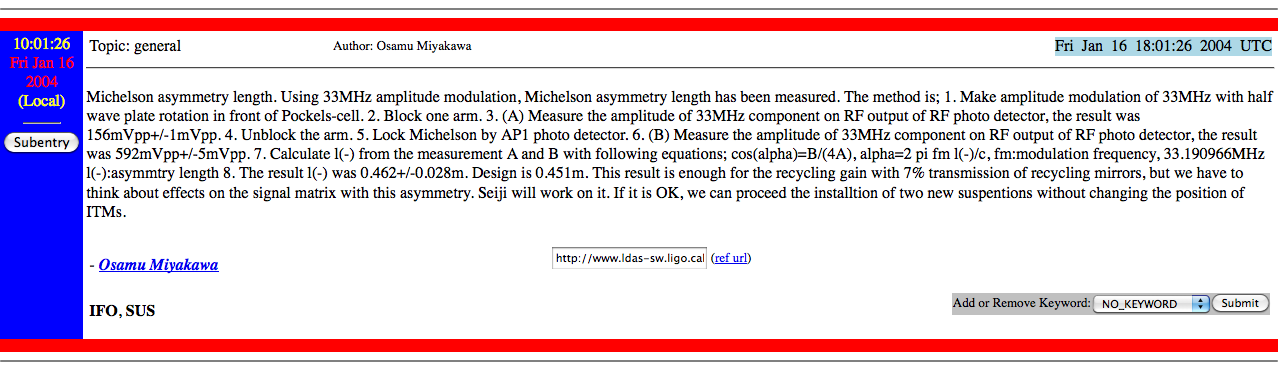
[4] J.Rollins, " Schnupp asymmetry measurement " 40m elog #4821 (2011)
[5] M.Rakhmanov et al, " Characterization of the LIGO 4km Fabry-Perot cavities via their high-frequency dynamic response to length and frequency variations " CQG (2004)
[6] A.Araya et al, " Absolute-length determination of a long-baseline Fabry-Perot cavity by means of resonating modulation sidebands " Applied optics (1999)
[7] M.Rakhmanov et al, " An optical vernier technique for in situ measurement of the length of long Fabry-Perot cavities " Meas.Sci.Technol (1999)
[8] R.ward, " Length Sensing and Control of an Advanced Prototype Interferometric Gravitational Wave Detector "PhD Thesis LIGO-P1000018-v1 (2010)
[9] K.Izumi, " Calibration of actuators : BS, ITMX and ITMY " 40m elog #4721
[10] P.Fritschel, " Digital Suspension Filter Design "LIGO-T010140-01(2001)
[11] V.Mandik, old elog entry (2004)
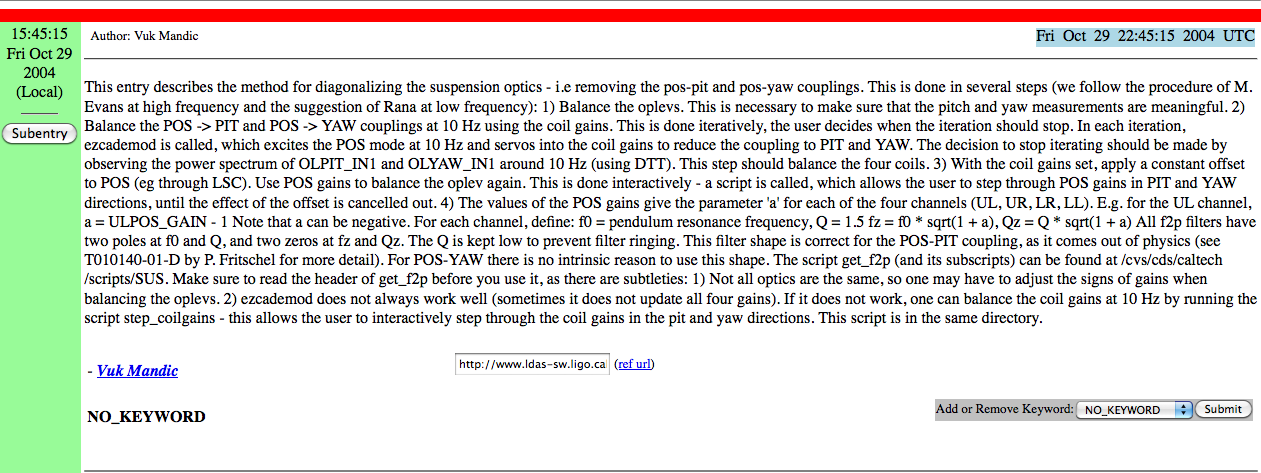
[12] A.Freise and K.Strain, " Interferometer Techniques for Gravitational-Wave Detection "Living Review (2010)