
|
Size: 5481
Comment:
|
Size: 8101
Comment:
|
| Deletions are marked like this. | Additions are marked like this. |
| Line 21: | Line 21: |
| ''Mug with Dry Ice in it. This is not appropriate for coffee, but is not bad for iced coffee'':[[BR]] | ''Mug with Dry Ice in it. This is not appropriate for coffee, but is not bad for iced coffee'' <<BR>> |
| Line 23: | Line 24: |
| <<ImageLink(mugice.jpg,MugIce,height=700)>> | [[MugIce|{{attachment:mugice.jpg||height=700}}]] |
| Line 25: | Line 26: |
| ''Coffee and Green (Coffee and Violet is coming soon)'' | ''Coffee and Green / Coffee Fluorescence'' |
| Line 27: | Line 28: |
| <<ImageLink(Coffee_and_Green.jpg,Coffee and Green,height=400)>> | [[Coffee and Green|{{attachment:Coffee_and_Green.jpg||height=300}}]] [[Coffee Fluorescence|{{attachment:violet_coffee.jpg||height=300}}]] |
| Line 29: | Line 32: |
| ''''' ''''' | <<BR>> <<BR>> |
| Line 31: | Line 34: |
| . [[BR]] [[BR]] | == What Coffee to Buy == 1. https://counterculturecoffee.com/learn/coffee-seasonality 1. For April: Columbia, Ethiopia, Uganda, Kenya |
| Line 33: | Line 38: |
| This is an example of a coffee disaster. Do not replicate such behavior. ''' ''' | -------- === Peet's === * Major Dickason (MJD) - Peets' reference; get this if you have no other opinions. * French Roast - Smoky, very bold, minimum acidity. Coffee for the work. Best for Cafe Au lait. * Italian Roast - Slightly weaker and a little more detailed than French Roast. Good with Italian sweets like Torrone. (probably?) * Kenya - more acidity. More complex flavor. * Sumatra - Similar to the dark roasts (French or Italian), but tastes like soil? or wood? Very good. * Guatemala - Peets' Latin American beans are not so great, but Guatemala is a nice combination of acidity and deep taste. |
| Line 35: | Line 47: |
| <<ImageLink(coffeedisaster.jpg,CofDis,height=400)>>[[BR]] -------- * Peet's * Major Dickason (MJD) - Peets' reference * French Roast - Smoky, very bold, minimum acidity. Coffee for the work. Best for Cafe Au lait. * Italizan Roast - Slightly weaker and a little more detailed than French Roast. Good with italian sweets like Torrone. (probably) * Kenya - more acidity. More complex flavor. * Sumatra - Similar to the darks (FR or IT), but tastes like soil? or wood? Very good. * Guatemara - Peets' Latin American beans are not so applaudable, but Guatemara is nice combination of acidity and deep taste. |
==== Some premium Peet's: ==== * JR Reserve - x4 price of usual. Quite elegant taste. Deep flavor and long decay time in the mouth. But slight acidity makes the taste very light. The best in Peet's. * Kona - this is actually not so good. Do yourself a favor and just have this when you go to Kona. |
| Line 45: | Line 51: |
| * Ask Koji how to import Peets from Abroad * Some premium peets: * JR Reserve - x4 price/lb of usual. Quite elegant taste.Deep flavor and long decay time in the mouth. But slight aicdity makes the taste very light. The best in peets. * Surprisingly peets teas are also very good. * Ethiopian Yergacheffe * Jamaican Blue * Kona * Kauauai * Wagonga * Rwanda Karaba: has to be consumed immediately after brewing! score 15 @ 0 sec and score 1 @ 300 sec This is a NONO |
==== non-Peet's Coffees ==== * Ethiopian Yergacheffe * Jamaican Blue * Kona * Kauauai * Wagonga * Rwanda Karaba: has to be consumed immediately after brewing! score 15 @ 0 sec and score 1 @ 300 sec This is a NONO |
| Line 56: | Line 59: |
| * Coffee Ranking by Steve as of taste and smell on the scale of 0 to 100 | === Coffee Ranking by Steve as of taste and smell on the scale of 0 to 100 === |
| Line 58: | Line 61: |
| 1, 95 Wagonga: Sumatran Mandehling Organic, medium- strong dark roast,well rounded, smooth chocolatey.... "the best I ever had" Steve 4/25/2007, tested last 3/18/2010 |
1. 95 Wagonga: Sumatran Mandehling Organic, medium- strong dark roast,well rounded, smooth chocolateeee...."the best I ever had" Steve 4/25/2007, tested last 3/18/2010 1. 93 Wagonga: Kenya Masai AA, medium roast, not as full as Mandehling, great..... tested 5/26/2010 1. 92 Wagonga: Fairtrade Ethiopian Limu Organic, lighter roast, little-bit flowery-limy, broadly smooth, tested 6/9/2010 1. 75 Peet's : Major Dickerson....best local dark roast 1. 65 Starbucks: Home Bland of COSCO, medium roast, great value.... 1. 59 Wagonga: Fairtrade Honduran Marcala Organic, light roast, no tail, greenish-tree-bark without real character, tested 6/4/2010 |
| Line 61: | Line 68: |
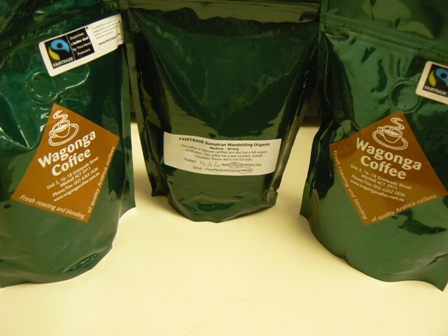
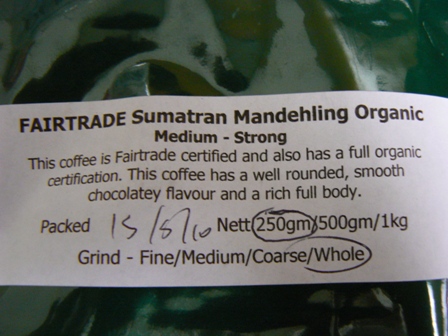
| 2, 75 Peet's : Major Dickerson....best local | '''''please make your own comments''''' 1. Alastair and Rana both like the Jones Roasters over near old town, but not the Jones style at the Red Door. 1. 'Arroyo Blend' is kind of sour, something like a medium roast at Peet's. John Miller has just arrived with new shipments of Wagonga Coffee from Australia on 9-21-2010.''' 1. I (Steve) checked in 250mgs of known as best " Sumatran Mandehling- medium strong roast. There are two more bags of unknown quality of Timor and Papua New Guinea. Thanks John {{attachment:P1060867.JPG}} {{attachment:P1060866.JPG}} |
| Line 63: | Line 76: |
| 3, 65 Starbucks: Home Bland of COSCO, medium roast, great value.... | ---- |
| Line 65: | Line 78: |
| 4, 64 Wagonga: Fairtrade Honduran Marcala Organic, light roast, no tail, greenish without real character | === Coffee Spectroscopy Articles === |
| Line 67: | Line 80: |
| * please make your own comments | 1. [[http://dx.doi.org/10.1016/j.talanta.2006.03.052 | Coffee varietal differentiation based on near infrared spectroscopy ]] 1. [[http://onlinelibrary.wiley.com/doi/10.1002/9780470027318.a1018/abstract | Near-Infrared Spectroscopy in Food Analysis]] 1. [[http://dx.doi.org/10.1016/j.aca.2004.08.057 | Prediction of sensory properties of espresso from roasted coffee samples by near-infrared spectroscopy ]] 1. [[http://dx.doi.org/10.1016/j.aca.2008.07.013 | Near infrared spectroscopy: An analytical tool to predict coffee roasting degree ]] 1. [[http://dx.doi.org/10.1016/j.jfoodeng.2006.04.042 | Discrimination of varieties of tea using near infrared spectroscopy by principal component analysis ]] 1. [[http://dx.doi.org/10.1016/j.jfoodeng.2006.04.042 | An evaluation of orthogonal signal correction methods for the characterisation of arabica and robusta coffee varieties by NIRS]] 1. [[http://dx.doi.org/10.1016/j.foodchem.2009.12.052 | Measurement of integrated absorption cross-section, oscillator strength and number density of caffeine in coffee beans by integrated absorption coefficient technique ]] 1. [[http://pubs.acs.org/doi/abs/10.1021/jf970337t | Near- and Mid-Infrared Spectroscopies in Food Authentication: Coffee Varietal Identification ]] 1. [[http://link.springer.com/article/10.1007/s00217-010-1362-z/fulltext.html | Strontium and oxygen isotope fingerprinting of green coffee beans and its potential to proof authenticity of coffee ]] 1. [[http://dx.doi.org/10.1094/CCHEM.2003.80.3.346 | Authentication of Rice Using Near-Infrared Reflectance Spectroscopy ]] |
Coffee
Power failure / breaker - Using the microwave and the coffee maker at the same time on the same circuit will trip the breaker. Don't do this or we'll have to exile you to Millikan for a week.
Types of Coffee - Peet's is good. Whatever Bram sent us is good too. Jamaican Blue Mountain is also nice. And we like real Kona. Please don't make artificially flavored coffees (e.g., vanilla) in the Zojirushi coffee maker--it taints the flavor of later pots
* 'Water Quality: please use Arrowhead water from the chiller ! ( thanks to AJW )It is essential to get distinctive flavor through as you brew Mug with Dry Ice in it. This is not appropriate for coffee, but is not bad for iced coffee Coffee and Green / Coffee Fluorescence
please make your own comments John Miller has just arrived with new shipments of Wagonga Coffee from Australia on 9-21-2010.
Water / C'mixture ratios - Full turn on the grinder with a medium grind corresponds to 6-6.5 cups of water (as measured by the maker). Don't vary from this ratio by very much or else we'll all be unhappy. (this section needs more info to deal with fine grinds and light roasts).


What Coffee to Buy
Peet's
Some premium Peet's:
non-Peet's Coffees
Coffee Ranking by Steve as of taste and smell on the scale of 0 to 100
- I (Steve) checked in 250mgs of known as best " Sumatran Mandehling- medium strong roast. There are two more bags of unknown quality of Timor and Papua New Guinea. Thanks John
Coffee Spectroscopy Articles
Coffee varietal differentiation based on near infrared spectroscopy
Near infrared spectroscopy: An analytical tool to predict coffee roasting degree
Discrimination of varieties of tea using near infrared spectroscopy by principal component analysis
Near- and Mid-Infrared Spectroscopies in Food Authentication: Coffee Varietal Identification
Authentication of Rice Using Near-Infrared Reflectance Spectroscopy