
|
Size: 2625
Comment:
|
← Revision 4 as of 2012-01-03 23:02:43 ⇥
Size: 2639
Comment: converted to 1.6 markup
|
| Deletions are marked like this. | Additions are marked like this. |
| Line 2: | Line 2: |
| . attachment:greenskeleton.jpg | . {{attachment:greenskeleton.jpg}} |
| Line 7: | Line 7: |
| I'd say the arm cavity length should not change more than 1/100 of the resonance width in the time scale of 10sec.[[BR]] For this to be fulfilled, the RMS fluctuation of the cavity length must be suppressed below 1e-11m level.[[BR]] ''Does this make sense ?'' | I'd say the arm cavity length should not change more than 1/100 of the resonance width in the time scale of 10sec.<<BR>> For this to be fulfilled, the RMS fluctuation of the cavity length must be suppressed below 1e-11m level.<<BR>> ''Does this make sense ?'' |
| Line 12: | Line 12: |
| When the cavity is locked to the green laser, the differential motion of the two mirrors will be suppressed by the servo.[[BR]] However, the common motion of the cavity mirrors will not be suppressed. This common motion will show up as phase noises [[BR]] of the lasers. The time derivative of phase noise is equivalent to frequency noise. The equivalent displacement noise seen [[BR]] by the cavity is dL=(w*x*L)/c, where w is the angular frequency, x is the displacement noise spectrum of the common motion, [[BR]] L is the length of the cavity and c is the speed of light (see [attachment:PhaseNoise.pdf attachment:PhaseNoise.pdf] for derivation). | When the cavity is locked to the green laser, the differential motion of the two mirrors will be suppressed by the servo.<<BR>> However, the common motion of the cavity mirrors will not be suppressed. This common motion will show up as phase noises <<BR>> of the lasers. The time derivative of phase noise is equivalent to frequency noise. The equivalent displacement noise seen <<BR>> by the cavity is dL=(w*x*L)/c, where w is the angular frequency, x is the displacement noise spectrum of the common motion, <<BR>> L is the length of the cavity and c is the speed of light (see [[attachment:PhaseNoise.pdf|attachment:PhaseNoise.pdf]] for derivation). |
| Line 14: | Line 14: |
| attachment:Cavity-Common-Diff.png | {{attachment:Cavity-Common-Diff.png}} |
| Line 16: | Line 16: |
| The two lasers (PSL and green) see the same motion of the cavity but from the opposite sides. Hence, the effect of this phase [[BR]] noise to the two error signals of the green and the PSL lasers will be 180 deg. out of phase. The feedback from the green laser to [[BR]] the cavity length will, therefore, create a noise for the PSL laser. | The two lasers (PSL and green) see the same motion of the cavity but from the opposite sides. Hence, the effect of this phase <<BR>> noise to the two error signals of the green and the PSL lasers will be 180 deg. out of phase. The feedback from the green laser to <<BR>> the cavity length will, therefore, create a noise for the PSL laser. |
| Line 18: | Line 18: |
| In order to estimate the contribution of this noise to the green lock, I plotted the estimated phase noise in the following figure.[[BR]] attachment:PhaseNoise.png | In order to estimate the contribution of this noise to the green lock, I plotted the estimated phase noise in the following figure.<<BR>> {{attachment:PhaseNoise.png}} |
| Line 20: | Line 20: |
| I first took a spectrum of ETMX OSEM pos signal to see the motion of the mirror with damping.[[BR]] The blue curve in the figure shows the calibrated OSEM spectrum using the well known 2V/mm OSEM [[BR]] calibration and the whitening filter shape (3Hz zero, 30Hz and 100Hz pole).[[BR]] However, OSEM signal is not a good measure of the seismic noise below the pendulum resonant frequency[[BR]] because the suspension cage and the mirror move together at low frequencies.[[BR]] As a tentative solution, I put a filter to make the spectrum look like 1/f^2 below 0.8Hz.[[BR]] This is diffinitely a hacky solution, and should be replaced with a correctly measured [[BR]] seismic spectrum. | I first took a spectrum of ETMX OSEM pos signal to see the motion of the mirror with damping.<<BR>> The blue curve in the figure shows the calibrated OSEM spectrum using the well known 2V/mm OSEM <<BR>> calibration and the whitening filter shape (3Hz zero, 30Hz and 100Hz pole).<<BR>> However, OSEM signal is not a good measure of the seismic noise below the pendulum resonant frequency<<BR>> because the suspension cage and the mirror move together at low frequencies.<<BR>> As a tentative solution, I put a filter to make the spectrum look like 1/f^2 below 0.8Hz.<<BR>> This is diffinitely a hacky solution, and should be replaced with a correctly measured <<BR>> seismic spectrum. |
| Line 22: | Line 22: |
| The estimated seismic motion was converted to the phase noise using the above formula.[[BR]] The RMS displacement noise above 0.1Hz is about 3e-12 m, which satisfies the requirement for [[BR]] the green lock stability (1e-11m). | The estimated seismic motion was converted to the phase noise using the above formula.<<BR>> The RMS displacement noise above 0.1Hz is about 3e-12 m, which satisfies the requirement for <<BR>> the green lock stability (1e-11m). |

Noise Requirement
I'd say the arm cavity length should not change more than 1/100 of the resonance width in the time scale of 10sec.
For this to be fulfilled, the RMS fluctuation of the cavity length must be suppressed below 1e-11m level.
Does this make sense ?
Noise Sources
PLL phase noise
Phase noise from the cavity common mode motion
When the cavity is locked to the green laser, the differential motion of the two mirrors will be suppressed by the servo.
However, the common motion of the cavity mirrors will not be suppressed. This common motion will show up as phase noises
of the lasers. The time derivative of phase noise is equivalent to frequency noise. The equivalent displacement noise seen
by the cavity is dL=(w*x*L)/c, where w is the angular frequency, x is the displacement noise spectrum of the common motion,
L is the length of the cavity and c is the speed of light (see attachment:PhaseNoise.pdf for derivation).
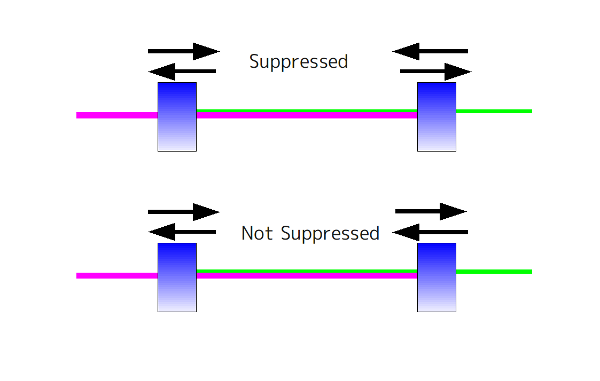
The two lasers (PSL and green) see the same motion of the cavity but from the opposite sides. Hence, the effect of this phase
noise to the two error signals of the green and the PSL lasers will be 180 deg. out of phase. The feedback from the green laser to
the cavity length will, therefore, create a noise for the PSL laser.
In order to estimate the contribution of this noise to the green lock, I plotted the estimated phase noise in the following figure.

I first took a spectrum of ETMX OSEM pos signal to see the motion of the mirror with damping.
The blue curve in the figure shows the calibrated OSEM spectrum using the well known 2V/mm OSEM
calibration and the whitening filter shape (3Hz zero, 30Hz and 100Hz pole).
However, OSEM signal is not a good measure of the seismic noise below the pendulum resonant frequency
because the suspension cage and the mirror move together at low frequencies.
As a tentative solution, I put a filter to make the spectrum look like 1/f^2 below 0.8Hz.
This is diffinitely a hacky solution, and should be replaced with a correctly measured
seismic spectrum.
The estimated seismic motion was converted to the phase noise using the above formula.
The RMS displacement noise above 0.1Hz is about 3e-12 m, which satisfies the requirement for
the green lock stability (1e-11m).