
|
Size: 1261
Comment:
|
Size: 5762
Comment:
|
| Deletions are marked like this. | Additions are marked like this. |
| Line 1: | Line 1: |
| = FREQUENCY OFFSET LOCKING = | = Frequency Offset Locking (FOL) for Dual Wavelength Laser Stabilisation = |
| Line 3: | Line 3: |
| '''Overview''' | == Overview == |
| Line 5: | Line 5: |
| In order for Absolute Length Measurement to be effective, the differential frequency (beat frequency) between prestabilized laser (PSL) and Auxiliary Laser (AUX) must remain constant. | In order for the Arm Length Stabilization (ALS) system to be effective in its purpose, the beat frequency between the AUX lasers and the PSL must be within the efficient working range of ALS (< 50 MHz). Thus, our purpose in Frequency Offset Locking (FOL) is to design a feedback-control loop that will keep this beat frequency well within the working range of ALS, so that manual tuning of auxiliary (AUX) laser frequencies may be avoided. |
| Line 7: | Line 7: |
| However, over time, the AUX frequency tends to wander due to things like temperature change. Thus, we employ our frequency offset locking (FOL) system. | Frequency offset locking works by sampling light from each laser source, PSL and AUX laser, and combining them to produce a beat note which corresponds to the difference between the frequencies of either laser. |
| Line 9: | Line 9: |
| Frequency offset locking works by sampling light from each laser source, PSL and AUX, and combining them, in-line, to produce a beat note. The value of which corresponds to the difference between the frequencies of either laser. | The combined PSL and AUX light is sensed at an RF photodiode and an RF frequency counter is used to measure the beat frequency. A digital PID control loop compares the detected beat frequency with the desired beat frequency to produce an error signal. The error signal is then converted back to an analog signal, to actuate on the temperature of the crystal in the AUX laser to keep its frequency within the desired range. |
| Line 11: | Line 11: |
| This light is then fed into a photodiode, the signal from which is digitized, and sent into a digital PID control loop. The PID Controller uses this signal as the current state of the system, which is further analyzed to produce an error signal. | == Schematic == A schematic of the setup for FOL is shown below: |
| Line 13: | Line 14: |
| The error is then converted back to an analog signal, which actuates upon the frequency of the AUX laser, keeping it within the desired range. | {{attachment:FOLschematic.png||height=600}} |
| Line 15: | Line 16: |
| The actuator is a temperature control, which controls the dimensions of the crystal resonator within the NPRO via thermal expansion. | ---- |
| Line 17: | Line 18: |
| Through this scheme, we hope to effectively achieve a constant frequency offset between the AUX and PSL. | == Project Tasks == ||'''Tasks'''||Who||Status||Last updated|| ||||||''General tasks''|| ||Make procurements list and purchase stuff||MT||Done||Oct 9|| ||Find out the fiber mode with collimator||MT||Waist of output beam = 210um ||Oct 16|| ||||||''Y End laser fiber setup''|| ||Waist of beam from doubling crystal||MT||Elog 10287 --> Waist = 40.2um|| Oct 9|| ||Designate space for the setup at end tables||MT||~30cm of propagation distance available||Oct 13|| ||Design telescopes for coupling light into the fiber||MT||converging lens f=12cm||Oct 13|| ||Assemble end telescope and couple light into fiber||MT||Status - elog 10638||Oct 24|| ||Layout the fiber along 40m arms in insulated tubes||MT+help ||Laid out||Nov 5|| ||||||''PSL fiber setup''|| ||Waist of beam from doubling crystal||MT||Elog 10287 --> Waist = 43.5um|| Oct 23|| ||Designate space on PSL table||MT ||Lot of space available||Oct 23|| ||Find out the fiber mode with collimator||MT||Waist of output beam = 176um ||Oct 23|| ||Design telescopes for coupling light into the fiber||MT||f_1=75mm@z=10.4cm+f_2=-1m@z=32.3cm with target @z=40cm||Oct 23|| ||Assemble end telescope and couple light into the fiber||MT||Temporary telescope in place ||Nov 5|| ||||||||''X End laser fiber setup''|| ||Waist of beam from doubling crystal||MT|| || || ||Designate space for the setup at end tables||MT|| || || ||Design telescopes for coupling light into the fiber||MT|| || || ||Assemble end telescope and couple light into fiber||MT|| || || ||Layout the fiber along 40m arms in insulated tubes||MT+help ||Laid out||Nov 21|| ||||||''Beat note setup''|| ||Make fiber chassis layout|| MT || Done || Nov 21|| ||Setup fibers in the fiber chassis||MT || || || ||Couple fiber to fiber||MT|| || || ||Combine PSL and end laser with appropriate polarization (50/50 --> 90/10)||MT|| || || ||Detecting beatnotes at the PD||MT || || || ||||||||''Frequency counter setup''|| ||Hook up frequency counter||MT || || || || Check FC acquisition scripts||MT || || || ||Read beat frequency on StripTool|| MT|| || || ||Mount FC module on IOO rack|| MT+help|| || || ||||||''End laser thermal actuator characterization''|| ||||||''Digital servo''|| ||||||''MISC tasks''|| ||Behavior of PM fiber to temperature fluctuations|| || || || ||Polarization controller characterization|| || || || == Procurements list == ||'''Component'''||'''Quantity needed/procured'''||'''Part number'''||'''Order status'''|| ||70m PM fiber||4+1/4+1||Corning PM98-U25A||Procured|| ||6 axis fiber mount||4/4||Thorlabs K6XS||Procured|| ||Fiber insulating tubes||1/1||-||Procured|| ||Polarization controller||1/1||Acrobat PCM4102-333|| Procured|| ||Fiber coupled PD||2/2||--(Thorlabs)-- Menlo FPD310||Procured|| ||Frequency counter||4/2||Minicircuits UFC6000||Procured|| ||'''OPTICS & OPTOMECHANICS'''|| ||Fiber mounting adapters||4/4||Thorlabs SM1FCA||Procured|| ||Fiber collimators ||6/6||Thorlabs CFC-2X-C||Procured|| ||Fiber collimator mounts||6/6||Thorlabs AD9.5F||Procured|| ||HR1064 mirrors||used mirrors in stock||CVI Y1 mirrors||Procured|| ||Lenses for telescopes||used lenses in stock||?||Procured|| ||Fiber BS for splitting PSL light between the arms(PM = PM+PM in 50-50)||1/1||Afw Tech POBC-64--C-(s)PM-7-2-25 dB|| Procured|| ||PM fiber mating sleeves PM FC/APC & (FC/APC)||6,4/0||Thorlabs ADAFCPMB2&ADAFCB3||Procured|| ||PM and SM fiber patch cables||multiple lengths||Thorlabs||Procured|| ||Fiber BC for beat note between arm and PSL (PM+PM=SM)||2/2||Afw tech POBC-64-C-1-7-2-25 dB||Procured|| ||Fiber BS for splitting combined light between PD and pick off (SM 10-90)||2/2||Afw Tech FOSC-1-64-10-C-(s)3m-H64-2||Procured|| ||Fiber chassis||1/1||Front Panel Express||Procured|| == Other links == [[\Frequency Counter Characterization]] == Notes == * The transimpedance gain for the Menlo FPD 310 is hard to find. After a few emails with the company's technical team, the information we have now is that it has 50ohm RF transimpedance, and an RF amplifier with a gain of '''+42 dB'''. Assuming an InGaAs sensitivity of 0.65A/W @ 1064nm, this means that we get '''4092 V/W''' at the nominal gain setting. If the ''attenuation'' setting on the PD is set to 20dB, the number becomes '''409 V/W'''. This PD is actually obsolete as per the Thorlabs catalog. The manual [[attachment:FPD310-Manual.pdf]] I found from the Thorlabs website is in the Attachments section of this page. |
Frequency Offset Locking (FOL) for Dual Wavelength Laser Stabilisation
Overview
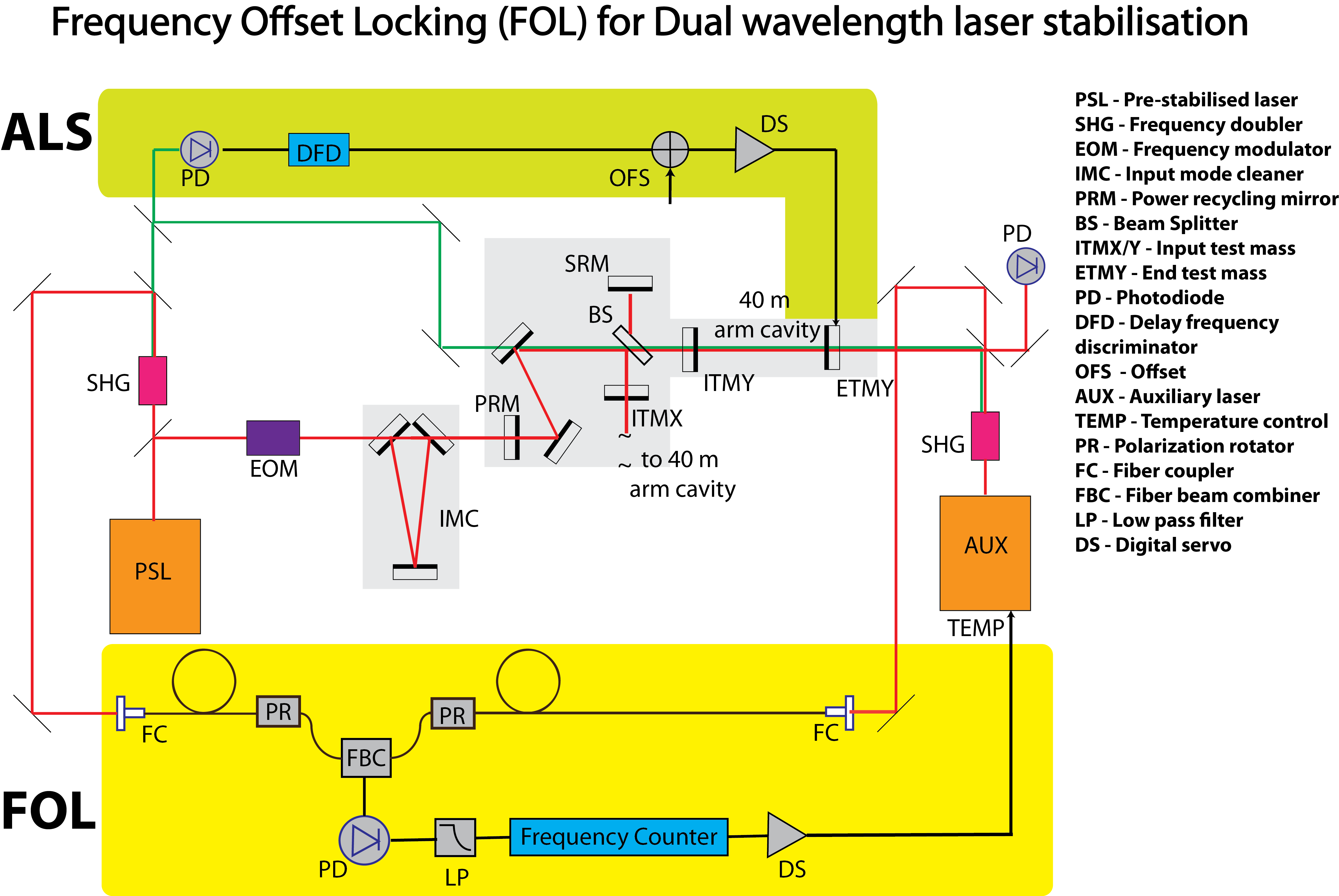
In order for the Arm Length Stabilization (ALS) system to be effective in its purpose, the beat frequency between the AUX lasers and the PSL must be within the efficient working range of ALS (< 50 MHz). Thus, our purpose in Frequency Offset Locking (FOL) is to design a feedback-control loop that will keep this beat frequency well within the working range of ALS, so that manual tuning of auxiliary (AUX) laser frequencies may be avoided.
Frequency offset locking works by sampling light from each laser source, PSL and AUX laser, and combining them to produce a beat note which corresponds to the difference between the frequencies of either laser.
The combined PSL and AUX light is sensed at an RF photodiode and an RF frequency counter is used to measure the beat frequency. A digital PID control loop compares the detected beat frequency with the desired beat frequency to produce an error signal. The error signal is then converted back to an analog signal, to actuate on the temperature of the crystal in the AUX laser to keep its frequency within the desired range.
Schematic
A schematic of the setup for FOL is shown below:
Project Tasks
Tasks |
Who |
Status |
Last updated |
General tasks |
|||
Make procurements list and purchase stuff |
MT |
Done |
Oct 9 |
Find out the fiber mode with collimator |
MT |
Waist of output beam = 210um |
Oct 16 |
Y End laser fiber setup |
|||
Waist of beam from doubling crystal |
MT |
Elog 10287 --> Waist = 40.2um |
Oct 9 |
Designate space for the setup at end tables |
MT |
~30cm of propagation distance available |
Oct 13 |
Design telescopes for coupling light into the fiber |
MT |
converging lens f=12cm |
Oct 13 |
Assemble end telescope and couple light into fiber |
MT |
Status - elog 10638 |
Oct 24 |
Layout the fiber along 40m arms in insulated tubes |
MT+help |
Laid out |
Nov 5 |
PSL fiber setup |
|||
Waist of beam from doubling crystal |
MT |
Elog 10287 --> Waist = 43.5um |
Oct 23 |
Designate space on PSL table |
MT |
Lot of space available |
Oct 23 |
Find out the fiber mode with collimator |
MT |
Waist of output beam = 176um |
Oct 23 |
Design telescopes for coupling light into the fiber |
MT |
f_1=75mm@z=10.4cm+f_2=-1m@z=32.3cm with target @z=40cm |
Oct 23 |
Assemble end telescope and couple light into the fiber |
MT |
Temporary telescope in place |
Nov 5 |
X End laser fiber setup |
|||
Waist of beam from doubling crystal |
MT |
|
|
Designate space for the setup at end tables |
MT |
|
|
Design telescopes for coupling light into the fiber |
MT |
|
|
Assemble end telescope and couple light into fiber |
MT |
|
|
Layout the fiber along 40m arms in insulated tubes |
MT+help |
Laid out |
Nov 21 |
Beat note setup |
|||
Make fiber chassis layout |
MT |
Done |
Nov 21 |
Setup fibers in the fiber chassis |
MT |
|
|
Couple fiber to fiber |
MT |
|
|
Combine PSL and end laser with appropriate polarization (50/50 --> 90/10) |
MT |
|
|
Detecting beatnotes at the PD |
MT |
|
|
Frequency counter setup |
|||
Hook up frequency counter |
MT |
|
|
Check FC acquisition scripts |
MT |
|
|
Read beat frequency on StripTool |
MT |
|
|
Mount FC module on IOO rack |
MT+help |
|
|
End laser thermal actuator characterization |
|||
Digital servo |
|||
MISC tasks |
|||
Behavior of PM fiber to temperature fluctuations |
|
|
|
Polarization controller characterization |
|
|
|
Procurements list
Component |
Quantity needed/procured |
Part number |
Order status |
70m PM fiber |
4+1/4+1 |
Corning PM98-U25A |
Procured |
6 axis fiber mount |
4/4 |
Thorlabs K6XS |
Procured |
Fiber insulating tubes |
1/1 |
- |
Procured |
Polarization controller |
1/1 |
Acrobat PCM4102-333 |
Procured |
Fiber coupled PD |
2/2 |
Thorlabs Menlo FPD310 |
Procured |
Frequency counter |
4/2 |
Minicircuits UFC6000 |
Procured |
OPTICS & OPTOMECHANICS |
|||
Fiber mounting adapters |
4/4 |
Thorlabs SM1FCA |
Procured |
Fiber collimators |
6/6 |
Thorlabs CFC-2X-C |
Procured |
Fiber collimator mounts |
6/6 |
Thorlabs AD9.5F |
Procured |
HR1064 mirrors |
used mirrors in stock |
CVI Y1 mirrors |
Procured |
Lenses for telescopes |
used lenses in stock |
? |
Procured |
Fiber BS for splitting PSL light between the arms(PM = PM+PM in 50-50) |
1/1 |
Afw Tech POBC-64--C-(s)PM-7-2-25 dB |
Procured |
PM fiber mating sleeves PM FC/APC & (FC/APC) |
6,4/0 |
Thorlabs ADAFCPMB2&ADAFCB3 |
Procured |
PM and SM fiber patch cables |
multiple lengths |
Thorlabs |
Procured |
Fiber BC for beat note between arm and PSL (PM+PM=SM) |
2/2 |
Afw tech POBC-64-C-1-7-2-25 dB |
Procured |
Fiber BS for splitting combined light between PD and pick off (SM 10-90) |
2/2 |
Afw Tech FOSC-1-64-10-C-(s)3m-H64-2 |
Procured |
Fiber chassis |
1/1 |
Front Panel Express |
Procured |
Other links
\Frequency Counter Characterization
Notes
The transimpedance gain for the Menlo FPD 310 is hard to find. After a few emails with the company's technical team, the information we have now is that it has 50ohm RF transimpedance, and an RF amplifier with a gain of +42 dB. Assuming an InGaAs sensitivity of 0.65A/W @ 1064nm, this means that we get 4092 V/W at the nominal gain setting. If the attenuation setting on the PD is set to 20dB, the number becomes 409 V/W. This PD is actually obsolete as per the Thorlabs catalog. The manual FPD310-Manual.pdf I found from the Thorlabs website is in the Attachments section of this page.