
|
Size: 381
Comment:
|
Size: 1104
Comment:
|
| Deletions are marked like this. | Additions are marked like this. |
| Line 1: | Line 1: |
| == Designing and implementing a thermal compensation system for the 40m arm cavity == | = Tuning Fabry-Perot cavity modal frequencies using controlled thermoelastic deformations on mirror surface = |
| Line 3: | Line 3: |
| The goal is to compensate for imperfections that arise due to optical inhomogeneities in the arm cavity mirrors by heating the ETM. The lessons learned from this exercise will help with designing/implementing a similar kind of system for the folding mirrors in the power recycling cavity. |
== Goal == To correct for the modal frequency shifts in the FP arm cavity that arise from the spatial inhomogeneities on the mirror surface. This will be done by imaging heat patterns on the mirror surface. The thermoelastic deformations The lessons learned from this exercise will help in designing/implementing a similar kind of system for the folding mirrors in the signal recycling cavity. == Fact-finding == 1. What are the ideal cavity parameters? (a reference to compare the different heating models) 2. Desired tuneable range and achievable range 3. Heaters and heating patterns 4. Practical/hardware limitations in implementing == Outline == [[attachment:CTD.pdf]] {{attachment:CTD.png|alt text|width=600 height=200}} == Simulation/Modelling == 1. Find the ideal/real cavity parameters (higher order mode degeneracy) - SIS 2. Frequency tuning - SIS 3. Heating patterns - COMSOL 4. Thermally perturbed cavity analysis - SIS |
Tuning Fabry-Perot cavity modal frequencies using controlled thermoelastic deformations on mirror surface
Goal
To correct for the modal frequency shifts in the FP arm cavity that arise from the spatial inhomogeneities on the mirror surface. This will be done by imaging heat patterns on the mirror surface. The thermoelastic deformations The lessons learned from this exercise will help in designing/implementing a similar kind of system for the folding mirrors in the signal recycling cavity.
Fact-finding
- What are the ideal cavity parameters? (a reference to compare the different heating models)
- Desired tuneable range and achievable range
- Heaters and heating patterns
- Practical/hardware limitations in implementing
Outline
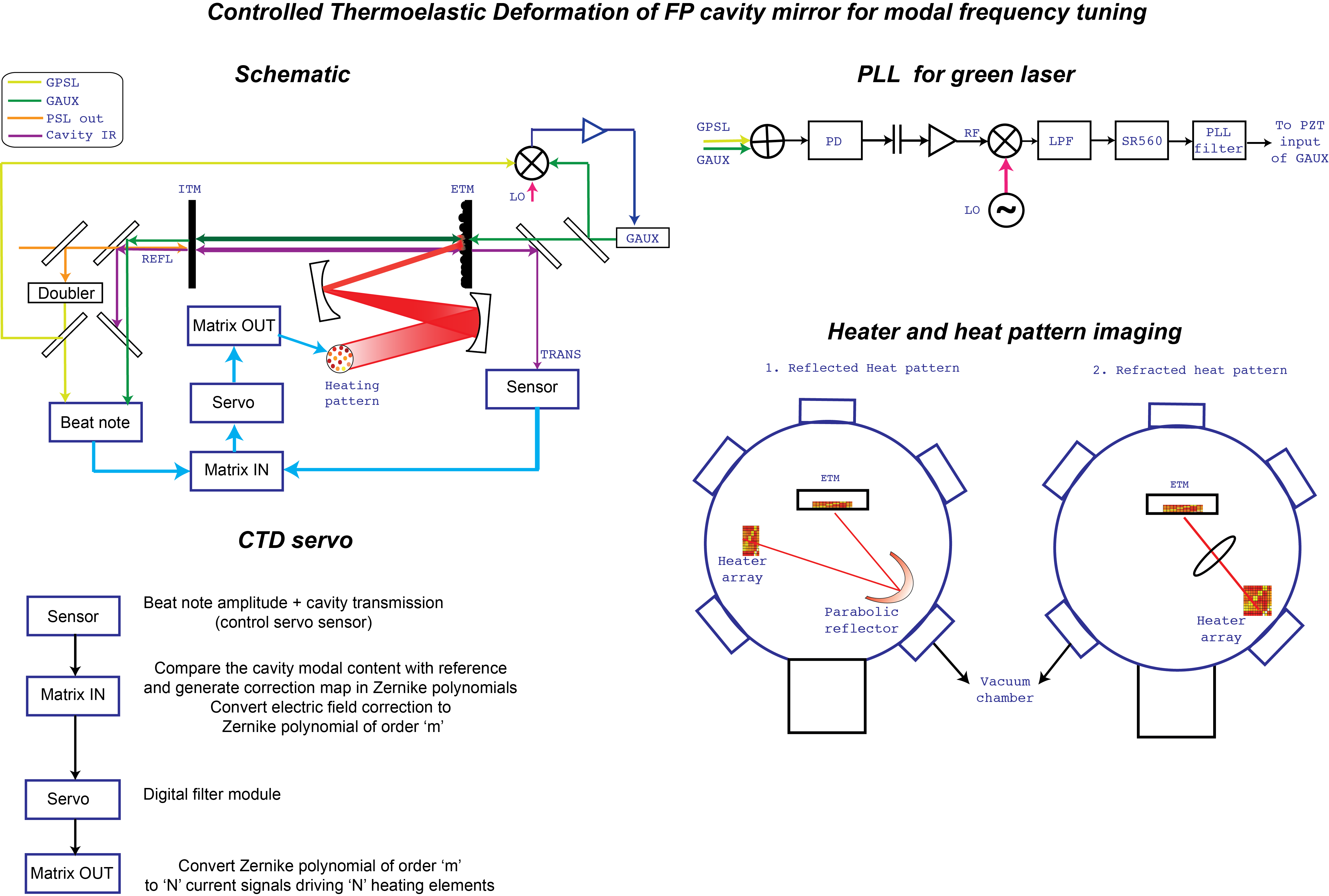
Simulation/Modelling
- Find the ideal/real cavity parameters (higher order mode degeneracy) - SIS
- Frequency tuning - SIS
- Heating patterns - COMSOL
- Thermally perturbed cavity analysis - SIS